
The Story of Keys: What Opens, What Doesn’t, and What We Carry
A desk, a single skeleton key, and a collection gathered over a lifetime. A story about what opens, what doesn’t—and what we carry with us along the way.
It’s a relic. I don’t know how it came into my family, but for me, it has always been there. My dad’s old, solid oak, roll top desk, manufactured a very long time ago by H. S. Crocker (founded in San Francisco in 1880, and, yes, related to the banking and railroad Crockers). There is a key; an old skeleton key. Just one. And when you roll down the top, the desk locks the top and all of the drawers. It is a pretty cool engineering marvel.
My dad didn’t work from home. He was a travelling salesman for Schwinn Bicycles for the early part of my childhood and owned a Schwinn Bicycle shop from the time I was about eight years old, clear through college and until he retired. But, he had this desk at home. It had his things in it, I discovered after both of my parents passed away; a slide rule, a couple of “wheels” to calculate mark up and compound interest, the sales brochure to the house I grew up in, including his mathematical equations to figure out the monthly mortgage payments. Artifacts.
For most of my childhood, my dad smoked cigars. He smoked in the house, in the car, in the bike shop, and, apparently, though I can never actually remember him sitting at his roll top desk, he smoked there, too. I know this because every now and then, the desk smells like cigar smoke. Not in the “cough, cough, ew” sense, but in the “Hi Dad” kind of way.
After my dad passed away, the desk became my mom’s. She sat there and wrote out checks to pay the bills. She kept a checkbooks ledger and a separate spiral bound, college ruled, notebook ledger, of the checks she wrote, month after month. Upon her passing, I discovered that this careful attention to detail dated several decades, predating my own creation.
The desk is mine now. It is decorated with my things, the drawers full of my things. But, some of those cool, secret cubby holes and compartments? My dad’s slide rule and calculation wheels are tucked there, just like he left them. I also have Mom’s last spiral bound notebook ledger. I don’t know why, it’s been ten years, I don’t think any bills went unpaid. But it lives in one of the super deep drawers and I really have no intention of shredding it like I did the other 50 years worth. A relic, an artifact, and continuity.
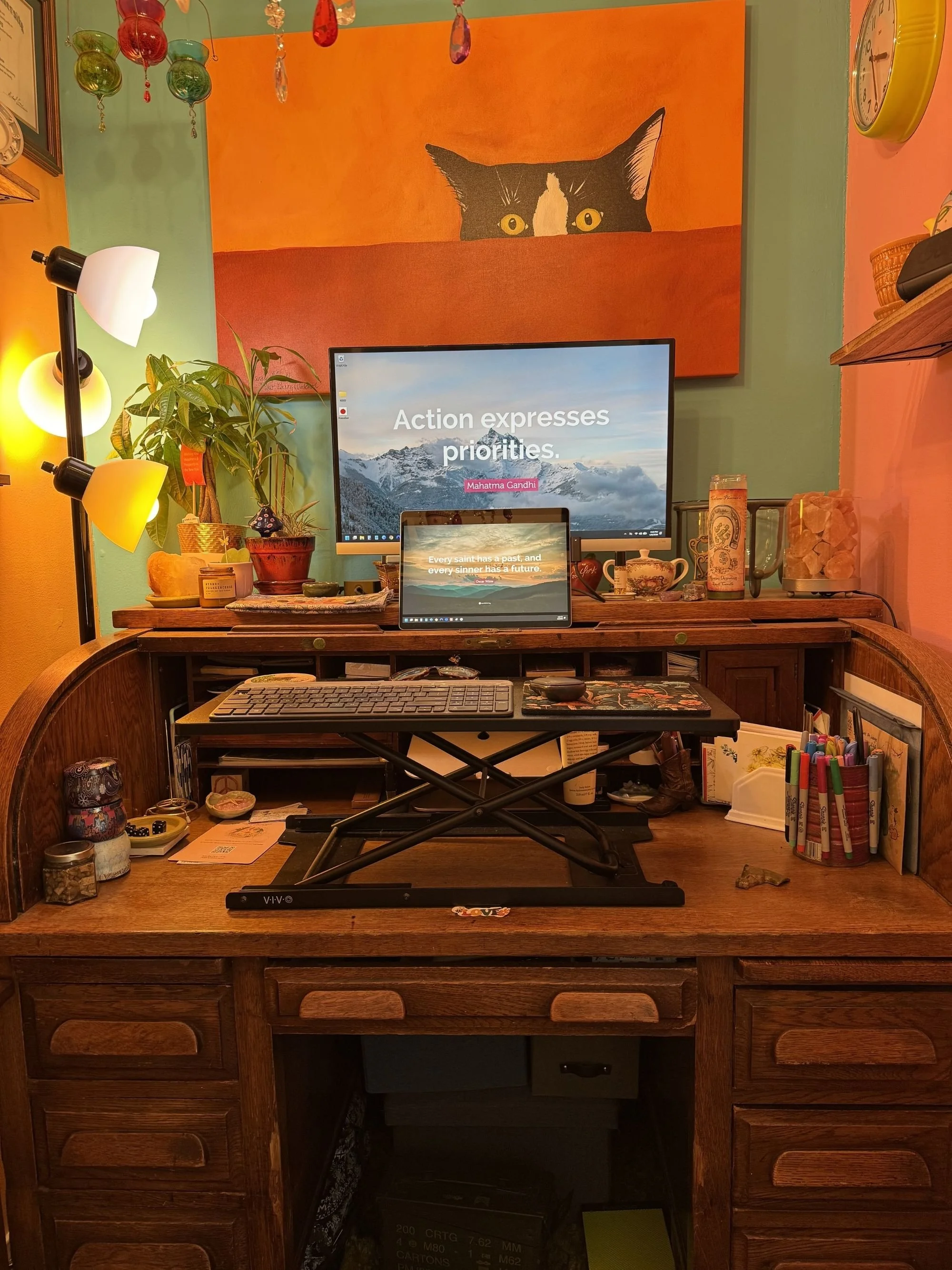
The desk is horrific to dust; all those cubby holes and little shelves. The roll top portion of the desk is ridged, which makes it especially hard to dust. And, of course, my things. Being a bit of a maximalist, there are quite a few things to move. And to dust. The desk, obviously, predates computers by several decades, but now holds an oversized monitor, a docking station for my PC, a “stand up desk” assembly, and all the other accouterments of modern desks. All of which must be moved, removed, disassembled, dusted, and then put back.
Dusting, generally, is my least favorite chore. I love cleaning. Just not dusting.
Especially “the desk”.
But, every now and then, the layer of dust gets the better of me and I stop everything to dust.
That is exactly what happened on one particular day. I decided to dust, and as long as I was at it, knowing it would be a good long time before I dusted again, I decided to do a really thorough job. What my mom would have called “damp dusting”; a damp cloth to remove the dirt, and a dry cloth, maybe with a little oil on it to dry and polish.
I usually keep the one, singular, remaining key in the lock itself. I went to dust the ridged roll top part of the desk, so I removed the key and placed it on the desk, rolled the top part way down and started dusting. Someone asked me a question, I turned to answer, and the desk decided to roll shut, locking the key inside. I will never forget the sound; a clatter, a thud, and a click.
At the time, I was running a very busy little bookkeeping practice from this desk. We closed early that day.
The remainder of the day was spent trying to figure out how to open the desk without a key. I can tell you from firsthand experience, ChatGPT will not give you advice on how to pick locks, no matter what logical reasons you provide for wanting to do so. I spent a lot of time on Google, which is how I know so much about H. S. Crocker company. Which, by the way, no longer exists. I spent a good portion of the day on YouTube watching lock pickers and scouring the house for hairpins, unbending paper clips, raiding the screwdriver drawer, and fashioning tools from bits or wire, old coat hangers, and various other odd, household items. Nothing worked.
One online suggestion was to “just buy skeleton keys”, there are only a couple of different styles and they are otherwise “pretty generic”. I ordered every skeleton key I could find off of Etsy and Amazon.
Until my packages arrived, I was conducting business from every other flat surface in the house, which was both inconvenient and uncomfortable. But at least I could afford to buy more skeleton keys.
And I was watching more YouTube videos in between tasks. By now, I could probably pick any lock in the world, except for my desk lock.
The packages began to arrive, one after another, day after day.
I would rip each package open and try the key. Some were too big around, others were too tiny. Too short, too long. More packages, more keys, no luck.
By this point, I was also trying to find a locksmith that might be “well versed” in “old desks with skeleton keys”. Most of those fellas are, themselves, skeletons.
Weeks passed and the final Etsy package arrived. I ripped it open, tried the key. No luck.
I was sitting on the floor, on the last bit of the 1970s, avocado green, shag carpet that sits under the massive desk; I was completely defeated. My phone lit up. It was a locksmith I’d left a message for a week before. They said that they might have someone available who could help. They quoted me a price which far exceeded what I’d spent online for skeleton keys, but I agreed.
Later that day I answered the door and found, unexpectedly, a very (very) young man standing there with a toolkit. I eyed the toolkit and it appeared to have in it everything I had already tried. But I let him in anyway and showed him the desk.
He went through the same series of implements and tools that I had tried; screwdrivers, paper clips, bits of wire in different gauges. Nothing worked. At his rate per hour, I was willing to pay for one hour. Only. I made this clear, in the most polite way I possibly could.
At minute 58, the young man turned and said, “I don’t want to break your desk, or mar it, but I am wondering whether I might be able to just pry it open. It might break the lock, but at least the desk might open.” I consented.
At minute 59, the young man pulled out the one tool I had not even considered; a pry bar. A big, heavy, blunt, metal pry bar. He edged the blade under the lip of the roll top and pried, gently at first. Nothing. At minute 59 and thirty seconds, he glanced at me, winced, and gave the pry bar a violent yank.
The desk opened. The desk was unharmed. The lock was unharmed. The young locksmith and I high fived, laughed, and I got out my checkbook (which, haha, had been locked in the desk drawer).
I learned a couple of lessons here.
First of all, dusting can have unpleasant consequences, LOL.
Second, try, try again, and then get the pry bar.
Third, keep the key on a keychain and hang it far away from the desk; which I’ve done.
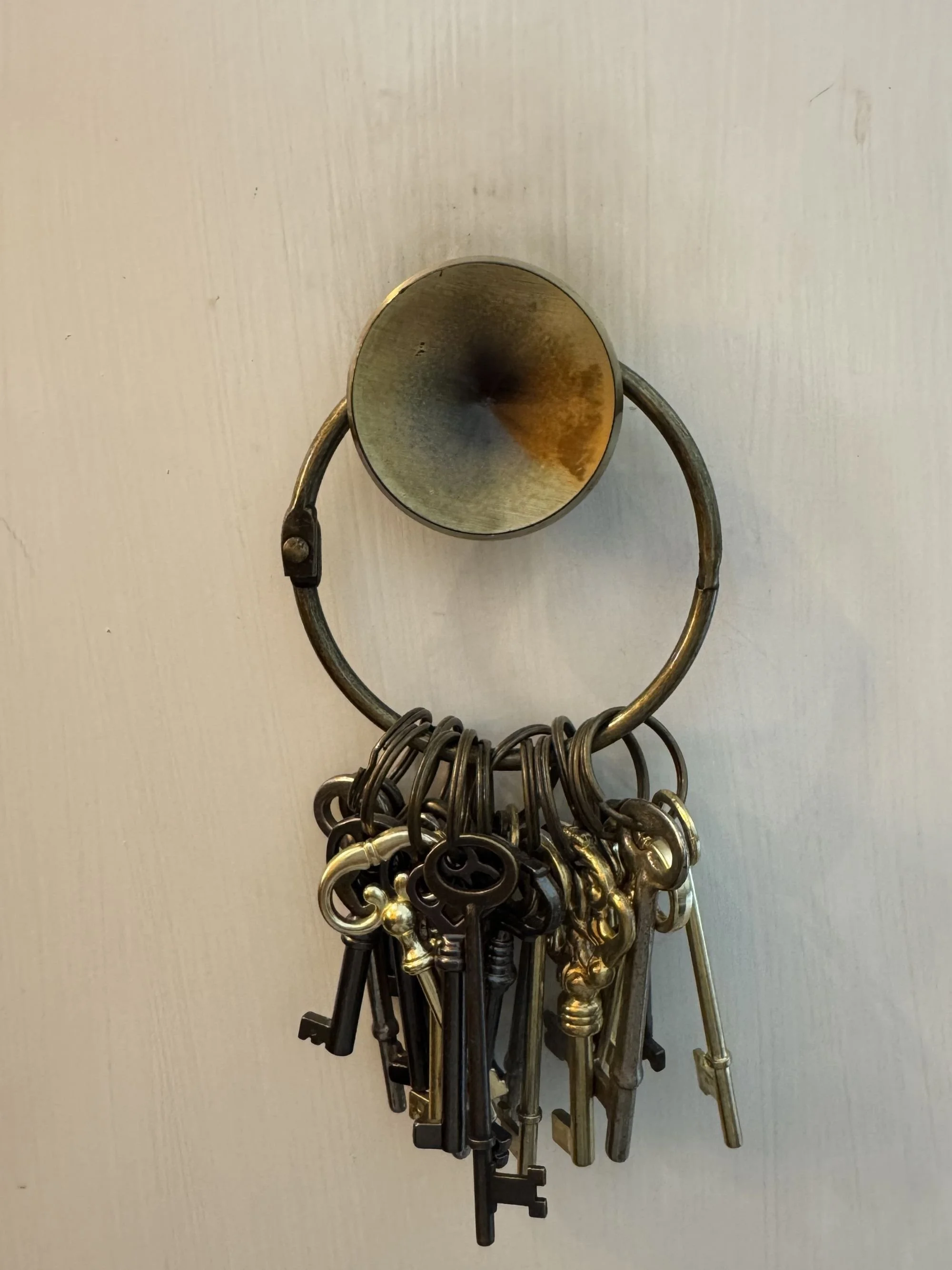
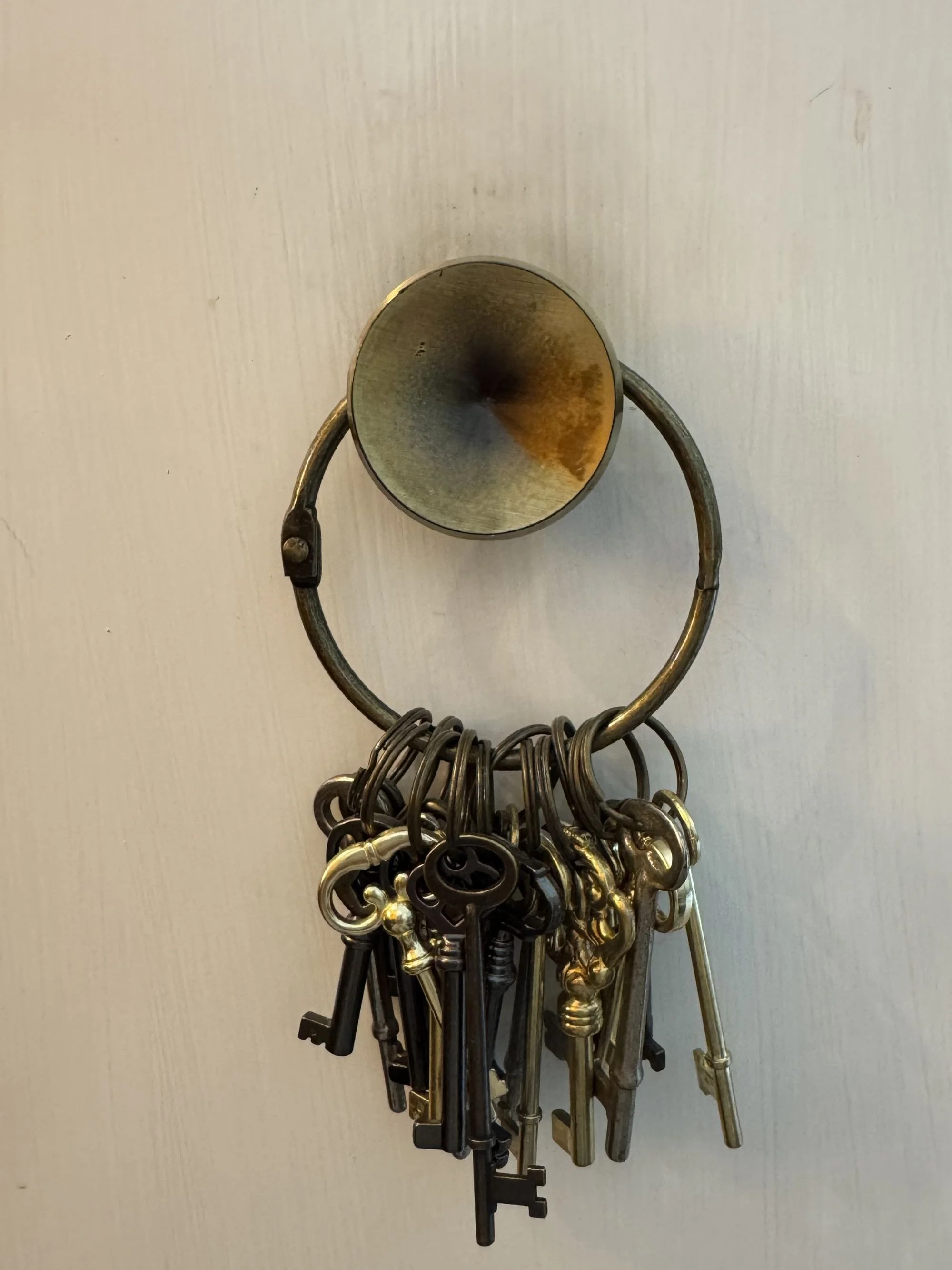
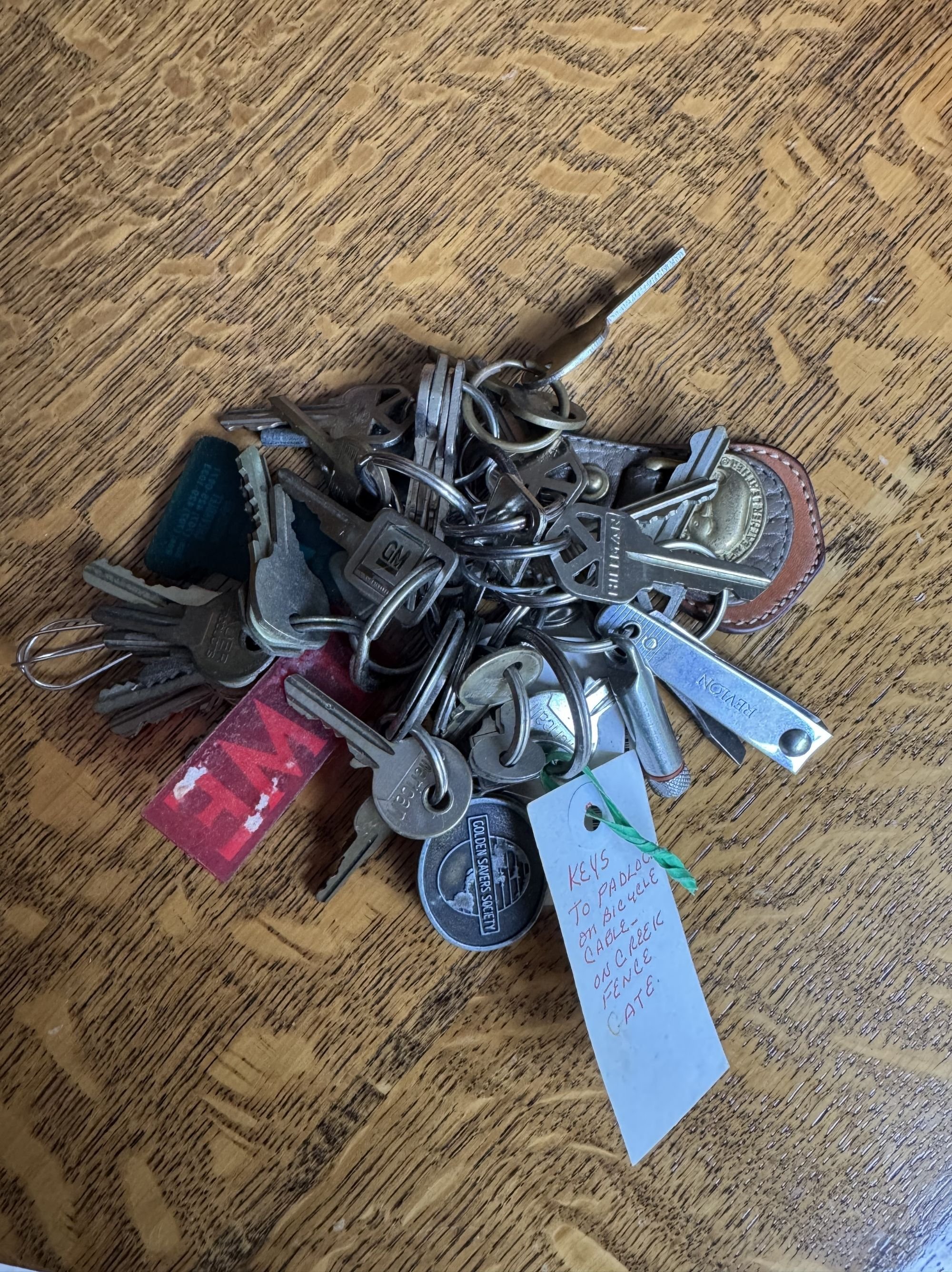
I actually love old skeleton keys. I think I got this from my mom. I don’t know. Or maybe there was an unwritten prequel to this story, because, when I cleaned out one of the drawers in the kitchen after both of my folks had passed away, I found an old Schwinn bag, and inside there were a dozen or so assorted skeleton keys. None of which, by the way, fit the desk lock. Had the desk locked itself once before and my dad bought a bunch of old skeleton keys to unlock it? I will never know. Anyway, I now have those skeleton keys, plus all the ones I bought, on a big, old keychain, hanging on a doorknob near (but not too close) to the old desk. That keychain also holds the one, the one and only, key that opens the desk.
When I look at that collection of keys, it reminds me that we all have a collection of keys—possible solutions—each intended for a specific lock or purpose. And, as we go through life, we collect these keys, and try them. Sometimes they unlock one lock, but not another. But, they all unlock some lock, somewhere. We may just have to be patient and a little persistent, and keep the keys safe, and handy.
And this is why, in the Whole Woman Joy Circle, we don’t build pillars.
Pillars are fixed. Heavy. Immovable.
Keys, on the other hand, are meant to be carried.
Collected. Tried. Revisited.
They fit in your pocket. They travel with you. They meet you where you are.
And over time, you begin to recognize— which key opens which door.
And which ones are worth keeping close.
If this idea of “keys over pillars” speaks to you…
That’s exactly the kind of work we do inside the Whole Woman Joy Circle.
A place for midlife women to explore what actually fits—
and to build a life that feels like their own.

Wiggling Sticks
My son flies Blackhawks for the Hawaii Army National Guard. He once told me flying a helicopter is basically just “wiggling sticks” — tiny constant adjustments that keep the aircraft moving smoothly. The more I thought about it (with LMFAO’s “wiggle wiggle wiggle…” looping in my head), the more I realized the same principle applies to midlife health.

From the day he was born, my son seemed destined for two things: to be an engineer and to fly.
At first it might have been a train engineer. But once Legos made the scene, it became clear he was going to engineer things, not necessarily trains.
A little over three decades later, yes, he is a mechanical engineer. And he flies Blackhawks for the Hawaii Army National Guard. A maintenance test pilot, to be exact. Which means he flies them after maintenance to make sure everything works exactly the way it should.
Which means, of course, that I am an actual helicopter parent.
And yes, I am very proud. The paths to both dreams were not direct, nor were they particularly easy. But they were forged.
As a mom, when your son flies what he sometimes calls “giant sky fans,” you try not to worry. I have been told hundreds of times not to. By the time Army pilots are trained and allowed to actually fly, they have practiced all the things to do if something goes wrong. I have also been told, many times, that helicopters can glide gently to the ground using something called autorotation if things simply… quit.
And they practice this.
Still.
Another thing my son once said has always stuck with me. He said flying a helicopter is basically just “wiggling sticks.”

Tiny movements. Constant movements. Small corrections that keep the aircraft flying smoothly in the desired direction and at the desired speed. And right side up.
The key is that the adjustments are small. Practically invisible. Often done without conscious thought.
Large, dramatic corrections?
Not so good.
Very bad, actually.
And somewhere in the back of my mind — perhaps it’s the matcha — the LMFAO song starts playing: “wiggle wiggle wiggle wiggle…”
Which I am fairly certain is not part of Army flight training, but the metaphor still holds.
And in this respect, flying a giant sky fan is not so different from roaming the earth in the body of a woman who has reached midlife. Or passed it.
Gone are the days when we can go on a drastic diet and drop a size or two in an instant. Gone are the days when we can simply do more cardio to “tone up.” We can’t skimp on sleep, recovery, or nourishment and just power through anymore.
Drastic measures not only stop working — they often work against us.
We are hormonally and chemically different than we were at twenty or thirty. The old care-and-maintenance manual no longer applies to our post-midlife bodies.
New rules. New procedures.
Wiggling sticks, not yanking levers.
The good news is we don’t have to learn to fly a helicopter to understand the concept.
We just need to start listening to our bodies again and making small adjustments.
Tiny movements. Tiny corrections. Tiny course changes that help us move smoothly in the direction we want to go.
What might that look like?
If we want to move our bodies more, we start with something simple. Maybe we add a daily walk. Not a three-hour gym session with cardio, weights, and a yoga class stacked on top of each other.
Once walking becomes part of the rhythm of our week, perhaps we add a strength class or a gentle yoga session.
Not both. Just one.
Small adjustments.
Or maybe we want to shift how we nourish ourselves. Instead of drastically cutting calories or eliminating entire food groups — which often increases stress hormones and encourages the accumulation of belly fat — we wiggle the sticks again.
We add nourishment.
A little more fiber.
A little more healthy fat.
A little more protein.
Suddenly we feel more satisfied. Our muscles, bones, brain, and gut microbiome get the support they need. Cortisol levels calm down. And our metabolism begins acting like a metabolism again.
This philosophy applies to nearly every aspect of midlife well-being: sleep, strength, flexibility, mindfulness, self-compassion, our environments, and even our relationships.
Small, responsive adjustments.
Not dramatic overcorrections.
These are the kinds of ideas and practices we explore together in the Whole Woman Joy Circle — gentle ways to “wiggle the sticks” so that we can move through this stage of life with greater steadiness, resilience, and ease.
A smoother journey.
In the direction we actually want to go.
And if all else fails, just remember: don’t yank the levers. Wiggle the sticks.
🌿 Curious about the Whole Woman Joy Circle?
Inside the Joy Circle we explore ideas like this together — how small, steady shifts can help us move through midlife with more strength, resilience, and joy.
Tiny adjustments.
Tiny course corrections.
A little like wiggling the sticks.
If you'd like to explore with us, you're warmly welcome.
Photos courtesy of aviation photographer John M. Dibbs.
Honestly, I did not cheat.
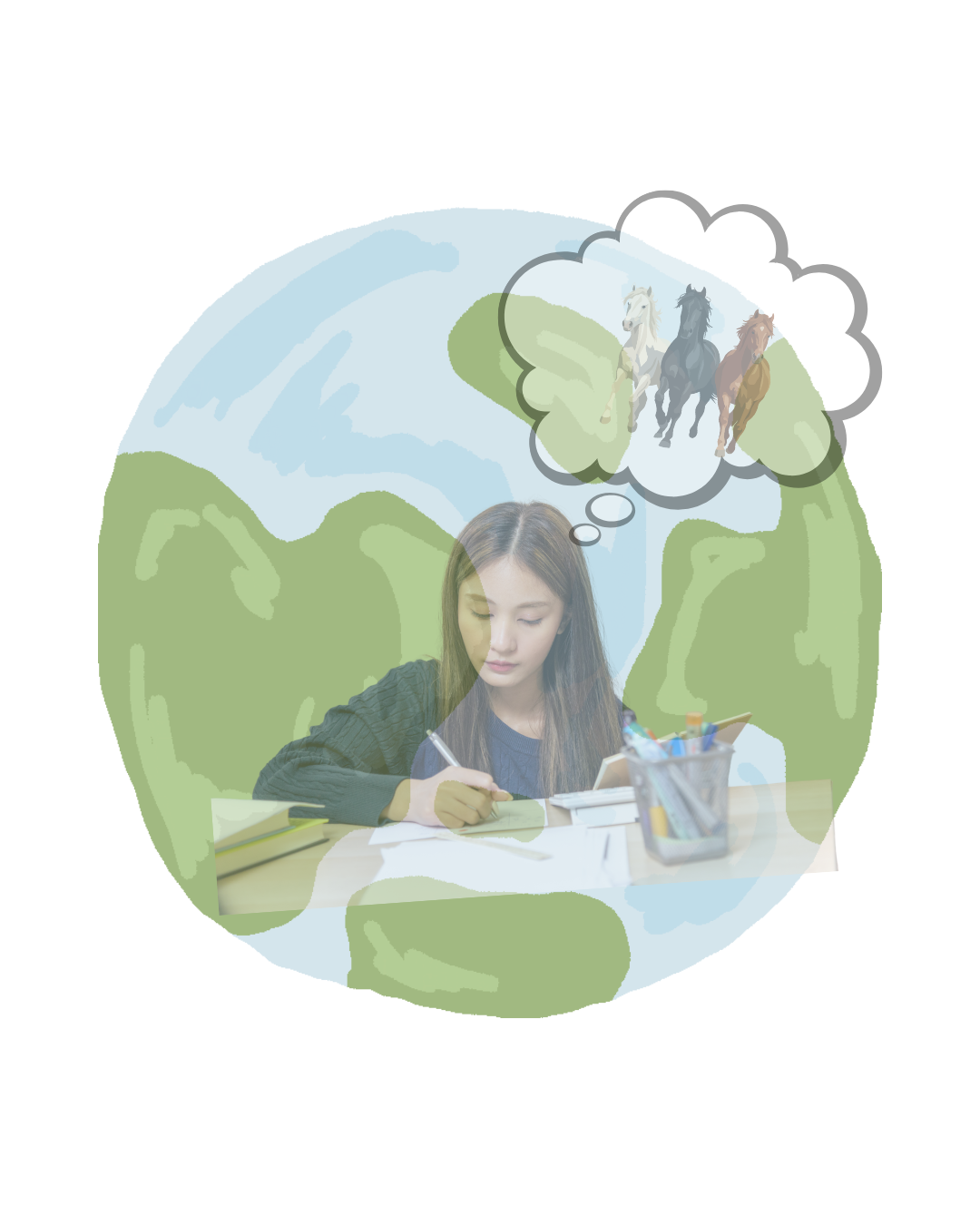
In middle school I created an entire imaginary world for a writing assignment. Maps, languages, governments, and—of course—horses. My teacher thought I cheated. Years later, I realized I was simply doing something I still love: building worlds.
When I was in middle school, I took a creative writing class. I have always loved writing. I think I express my thoughts much better in the written word than spoken. Writing gives me that extra moment or two to select the perfect words, to craft the best phrases.
When I speak, I pause in awkward places while I try to explain what I’m thinking. And for some reason, when I’m talking, the part of my brain that contains vocabulary and can cleverly arrange words in magical ways seems to be on break. As soon as I walk away from the conversation, my words and cleverness return. I always think of the perfect thing to say about an hour after I needed it.
When I write, I also get to proofread and edit. Once words spill out of my mouth, I can’t replace one with a better one or rearrange them for more impact and delight.
I am a fluent writer and a rather spastic speaker.
In my middle school creative writing class, I wrote my heart out. I remember the teacher vividly. I always liked him and was happy to be in his class. Now, middle school was a very, very long time ago, and some of the details are sketchy. I don’t remember whether I was excelling in the class, if my teacher liked my writing, or if I was struggling and he didn’t quite appreciate my style and wit.
What I do remember is that another class, a year ahead of us, was doing a really fun project and I desperately wanted to do it too. They had been assigned a writing project where they had to create a country. They had to include things like a map, describe the landscape, the government, the major cities, the economy, the language — everything. It sounded fascinating, and I wanted to do my own.
Then an opportunity appeared: a “free writing extra credit” assignment.
Like magic.
And I knew exactly what I was going to write.
I was going to create my country.
No — better than that.
I was going to create a whole world.
I was one of those horse-crazy girls. You know the type: the slightly awkward girls who gallop instead of run when they think no one is looking. Of course, people are always looking. When I first learned to speak, I’m fairly certain my first words were “mommy,” “daddy,” and then, “I want a horse.”
So naturally, if I had the chance to create a whole world, that world was going to revolve around horses.
I wrote and drew and clipped magazine pictures and pasted them into my project. I designed countries, cities, governments, economies, trade systems, and even languages. I was completely consumed by this project for weeks, and what I created felt so magical that I wanted to teleport to the world I’d invented.
When I finally handed in my project, I was beaming. I felt a bit like the kid in A Christmas Story when he hands in his letter to Santa asking for the Red Ryder BB gun.
Instead, I got a worse grade than his C.
I got an F.
Across the top page of the book I’d handed in was written: “See me after class.”
After class, choking back tears (which I’m not very good at), the teacher told me he knew I had cheated. He was certain I had copied a report from the other class or used one of the older students’ projects as my own.
I was devastated.
I went home and told my mom. She had seen me working on my project. She had heard about it night after night after night. I remember she wrote a note to the teacher. But I don’t remember how it all ended. What I do know is that after that, I never liked that teacher very much.
But I do remember my horse world.
I remember the magic. The joy. The delight of creating a little world of my own.
I had drawn maps and invented languages. Designed governments and trade routes. Pasted pictures from magazines and imagined what life would be like there.
It was the first time I realized that writing could create a place someone might want to visit.
Now, many years later, I find myself doing something similar again.
The Whole Woman Joy Circle is, in its own way, another little world. A place where women in midlife and beyond can gather to explore ideas, share stories, nourish themselves, and rediscover joy.
This time the world is built with conversations, invitations, recipes, walks, reflections, and laughter.
And just like that imaginary world I created in middle school, it begins with a small group of women who arrive first.
I’m calling them the First Circle.
They are the early explorers. The women who step into this little world first, help shape it, and watch it grow.
If you’ve been following along as this world begins to take form, you may be one of them.
And if so, I’d love to welcome you into the First Circle.
If you're curious about the little world that is just beginning to take shape, you can learn more about the Whole Woman Joy Circle here.
That Time I Dated Alaska
A story of saying yes in Fairbanks, Alaska — and the rhythms of light, tundra, and belonging.
On saying yes.
He was a very nice man. Nice looking, interesting, fun, thoughtful.
I was still married when I met him, not even separated yet. But we were just friends a couple of years until everything at home, and in my life, had changed.
I was traveling for work. A lot. With my career in accounting, financial statement audit in particular, I had taken a job with a large, multinational software company and traveled the U.S. teaching accountants and CPAs how to use a high end audit software. Each week, I was in a different city. The travel was exciting, fun, and enjoyable. It got me away from all the things I was trying to avoid at home.
Imagine my surprise when I was assigned a client in Fairbanks, Alaska! I’d never been to Alaska.
Friends and family were all concerned. A woman, traveling alone, to the Alaskan frontier. I was told “don’t venture out at night” and “don’t talk to any men” and “it’s really scary up there, there aren’t many women, so the men are rabid”. I can be pretty unflappable. I traveled by myself to New York City and walk the streets late at night, taking in the sights, the restaurants, and Broadway. I am not worried at all about Alaska. I have a good head on my shoulders and am a pretty good judge of character.
And I enjoy my week in Fairbanks thoroughly. I did all the sightseeing I possibly could; parks, geocaches, restaurants, museums, the university, and as many breweries as I could find. After my last day with the client, with my flight departing, purposefully, later the next day, so I have the morning to explore some more, I decided to head to a brewery in the neighboring town of Fox. I stroll in, no reservation, and it is crowded. Mostly families. As was my experience everywhere I’d been. Not rabid men. Moms, dads and their kids. The hostess asked if I wouldn’t mind sitting at the bar since I was a “single diner”. I was fine with that. I am comfortable at bars. Alone or otherwise.
I have a fantastic dinner of salmon. Luckily, I love salmon, because it’s about all I’ve eaten all week long. I order the stout on the menu; rich and dark. There are a small handful of folks at the bar. Mostly men. I took a bar stool at the center of the horseshoe shaped bar with at least two or three empty seats to both my right and left. As I’m finishing my locally made ice cream and my stout, someone sits right next to me. Yes, my spidey senses rose a bit, but I remained casual. It was a man, from what I could tell from my peripheral vision. Dark hair. Bearded. And what I noticed was that the bartenders and everyone at the bar greeted him in a friendly and favorable manner. Not like a serial killer or an ex-con or somebody “not nice”.
A few moments later “the man” turns to me and states, “you’re not from around here, are you?” Furthest thing from, and apparently obvious. We chatted and he was pleasant and a good conversationalist. I told him I was flying back to California the following day after going to the art museum at the university. He asked “have you ever ridden on an airboat?” The answer was no, and I had to think about what an airboat even was. Of course, what comes to mind is the vessel the dad on the old TV show “Flipper” used to cruise around the Florida everglades in. And, yes, that is an airboat. Next question, “would you like to go for a ride on my airboat tomorrow before you go to the airport?” Yes! But, no. I’ve not known this guy for more than ten minutes, every voice from home, and a few in my mind, are yelling, “are you crazy? You don’t go out on an unknown vessel with an unknown man anywhere, and especially an Alaskan man”. My answer? “Sure! Sounds great!”
And I didn’t sleep a wink. All night long one voice was saying “get out of it”, “don’t pick up the phone”, “don’t answer the text”, “make an excuse”. And the other voice was super excited about the adventure.
Bright and early, the text messages started. He offered to bring me coffee at my hotel. Um, nope. I stuck to my plan to go to the art museum at the university. And then, we’d see what the timing looked like; I didn’t want to miss my flight. He assured me there would be plenty of time for an airboat ride and lunch.
Several more text messages while I was at the art museum.
We arranged a meeting time and place. I parked my rental car, with my suitcases in the back. He arrived in his cool, vintage Ford truck, and I am a sucker for cool, old vintage trucks. Especially Fords. I’ve been a longtime driver of full-size Ford Broncos. Behind the truck is, I guess, an airboat. It is a shallow aluminum boat with what looks like a wooden airplane propeller attached to the back and, I’d guess, a “homemade” elevated chair apparatus. Just one chair apparatus. And a faded and well-worn folding lawn chair. This may be a bit more of an adventure than the most eager voice in my head is prepared for. But, here I am, and I don’t think I can outrun this guy.
I get in his truck. I can feel all of my friends and family back home gasp, cringe, and cover their eyes. But, remember, everyone at the bar regarded him well, so he probably wasn’t a serial killer. My logic.
We drive to a boat launch surprisingly nearby. I didn’t realize it, but there is a river that runs right through Fairbanks. Which is probably why the town is “Fairbanks”. He plops the boat in and unfolds the questionable lawn chair. It is in no way attached to the boat. I am instructed to sit in the lawn chair and to “be careful, because it isn’t attached” and then I am handed earmuffs like you’d wear for shooting. I put them on and the engine is started (after a few attempts). The propeller roars to life and it is deafening even with ear protection on.
And off we go. My chair immediately tips precariously to one side as we turn. It takes me a few moments to learn how to use every muscle in my body to keep the chair, and me, upright and in, I mean on, the boat.
It is exhilarating. We swoop and swish up (or down) the river.
Eventually, we dock at a lunch spot along the bank and disembark. We step inside, and, again, everyone knows the guy and seem genuinely happy to see him. I am introduced, and we have lunch and more pleasant conversation out on the deck of the restaurant.
After lunch, back in the boat, ear protection on, and we go immediately back to the launch. We say goodbye, I get back in my rental car, go to the airport, and fly home.
Alive. Unscathed.
Cross Fairbanks Alaska off my list. Add Alaska to the list of states I have visited. Chapter closed.
The guy and I texted back and forth. An occasional phone call. We had a dialogue. He talked about the vegetables he was growing, or the moose he and a friend shot; putting food on both of their tables for at least a year. He talked about “fish camp” and “gill netting” and “dip netting”; adding more food to his coffers for the winters to come. He told me about his crows that would come for food scraps he left out on the deck. One fledgling crow that he had eating out of his hand. He talked about his jobs; one as an auto body shop owner where he works primarily with people who can’t afford to have their cars fixed elsewhere. He got the job done for less, got them back on the road, and made less than the other auto body shops in town. He also drove the “haul road”, as a pilot car, for the loads navigating from the port in Valdez up to the ice fields in Prudhoe Bay. For the ice road truckers.
I talked about the latest city I traveled to; the food, the beer, the sights. I talked about my life in California; my kids, my parents, hiking and my running club.
Our lives could not be more different. Which made the friendship interesting.
A couple of years later, he decided to visit me in California. He always liked to take some time, mid-winter, when things are dark 24-7, and go somewhere sunny. His mom lived in the desert in the southern part of the state. But this year, he wanted to visit me.
I had no idea what to expect, but I kind of figured what was going to happen.
We dated for two years. Long distance. Very long distance.
It was a lot easier for me than for him. My job required me to fly, almost weekly. I had airline points and status and it was just as easy to book a “stop” in Fairbanks on my way home from, wherever, as it was to just fly home. A bit more time in the air, but I also earned more points! I was practically getting paid to fly to and from Alaska.
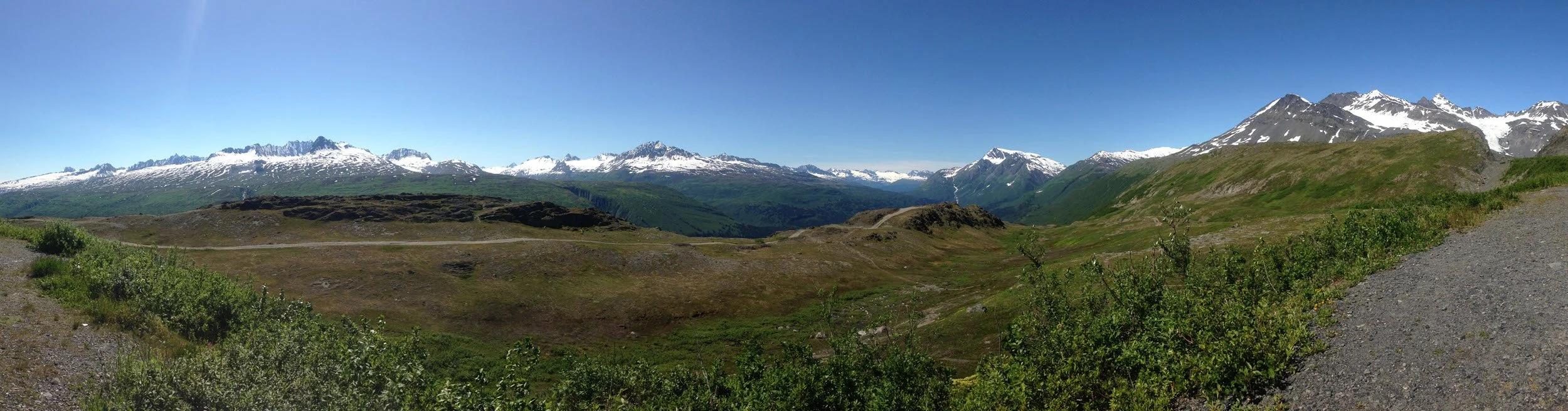
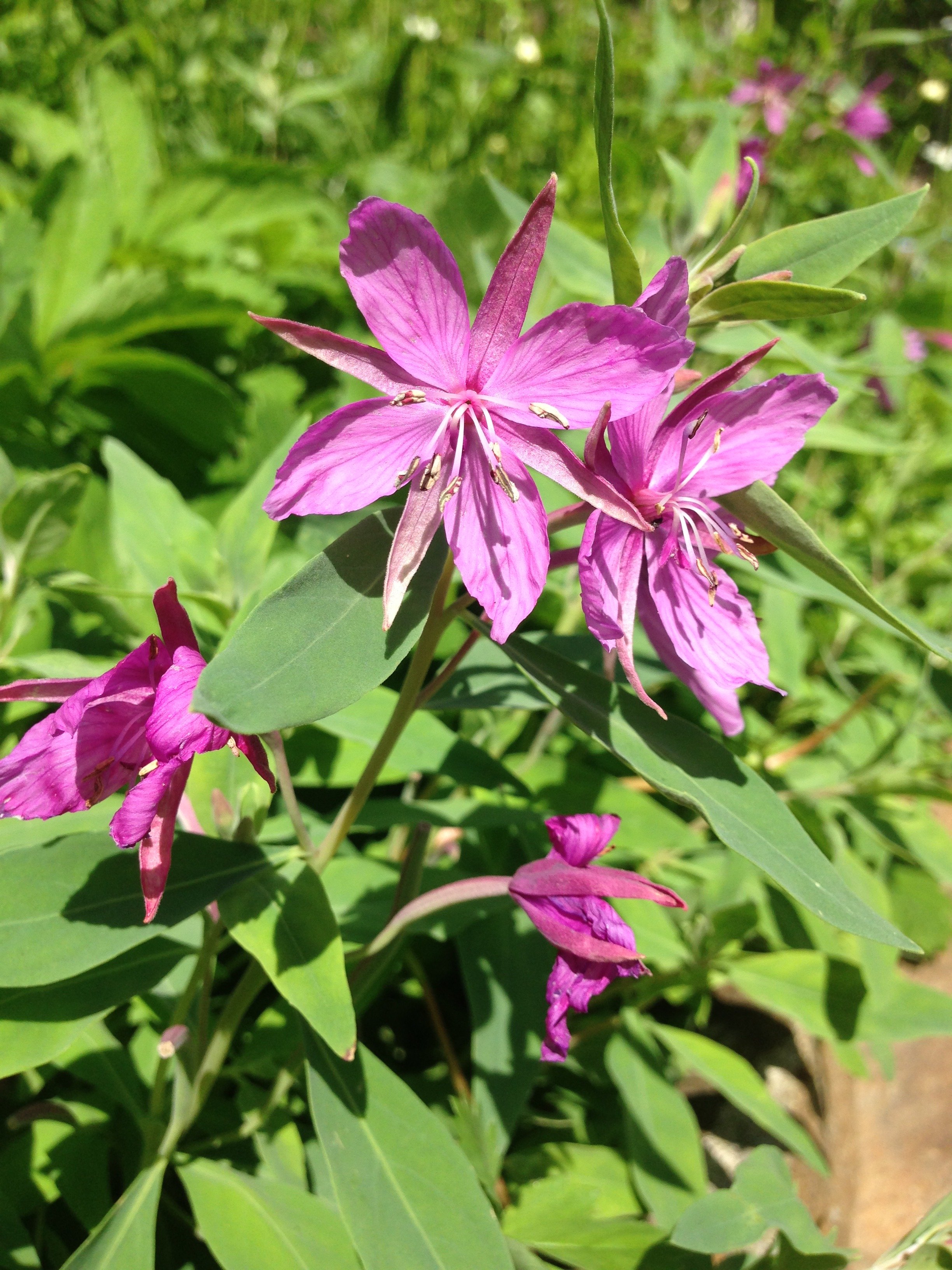
In those two years, I honestly don’t know how much cumulative time I spent there. A bunch. In a house in the woods. He’d built himself. Complete with running water and indoor plumbing. Though there was an old outhouse from before that upgrade. On a mountain. Thirty miles or so outside of Fairbanks. There were trails from his property out into the tundra. And if you have never experienced the tundra, do it! It’s magical! Like walking on sponges. Except there are wild blueberries and cranberries for the picking.
He built the house so that the windows all faced the hilltop where University of Alaska, Fairbanks had their research equipment for analyzing the aurora borealis. In other words, if the aurora was going, you could see it from any window in the house. We could see it from bed.
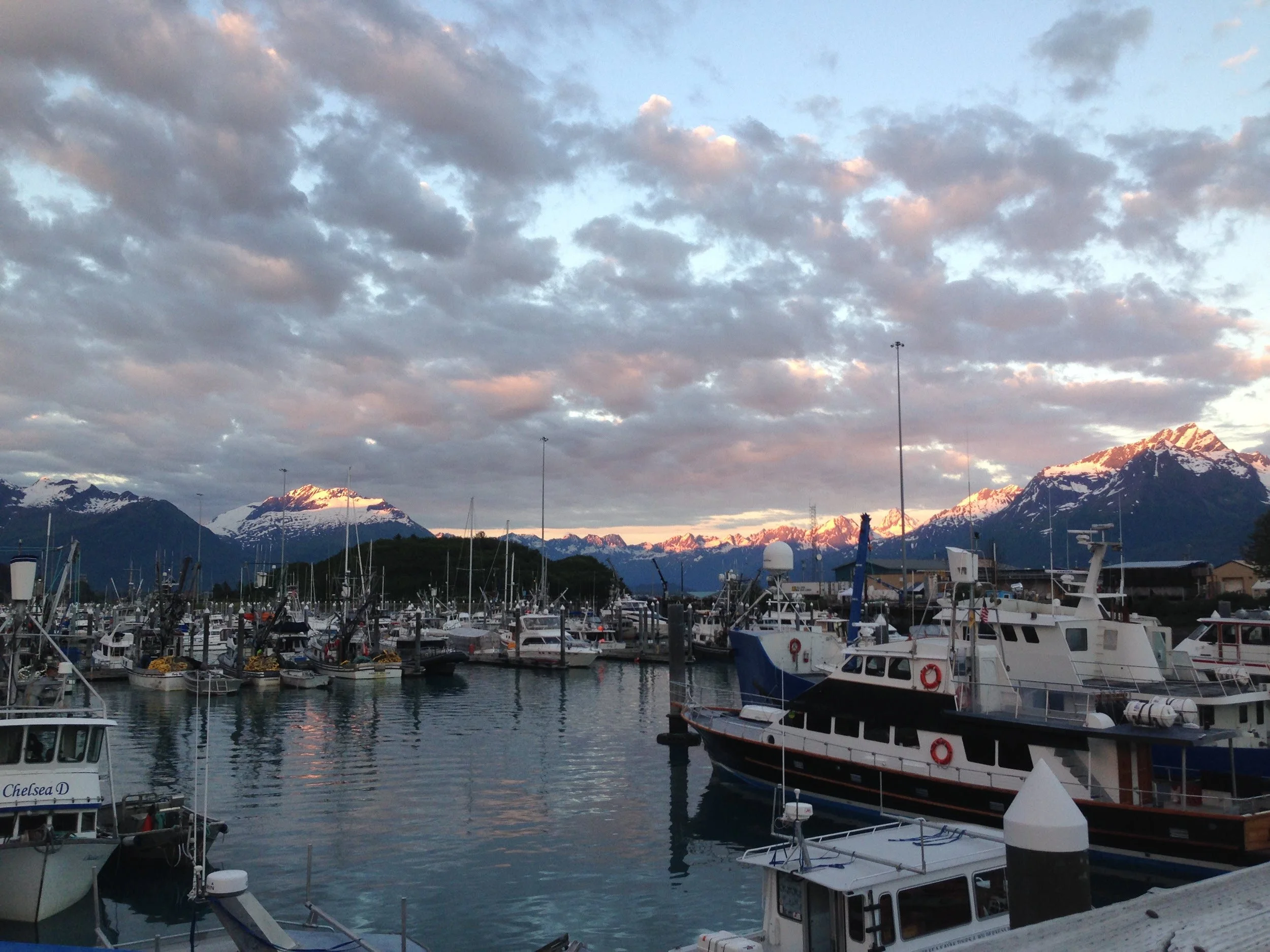
We rode “snow machines”, which I only ever knew as “snowmobiles”. And ATVs. We went airboating a lot. And I got to ride along, on occasion, on the “haul road” as he piloted trucks with long loads of pipe up to Prudhoe Bay. I have been beyond the Arctic Circle. I have seen, in fact, every inch of the pipeline from Valdez to Prudhoe Bay. Maybe not every inch, but I have traveled its length.
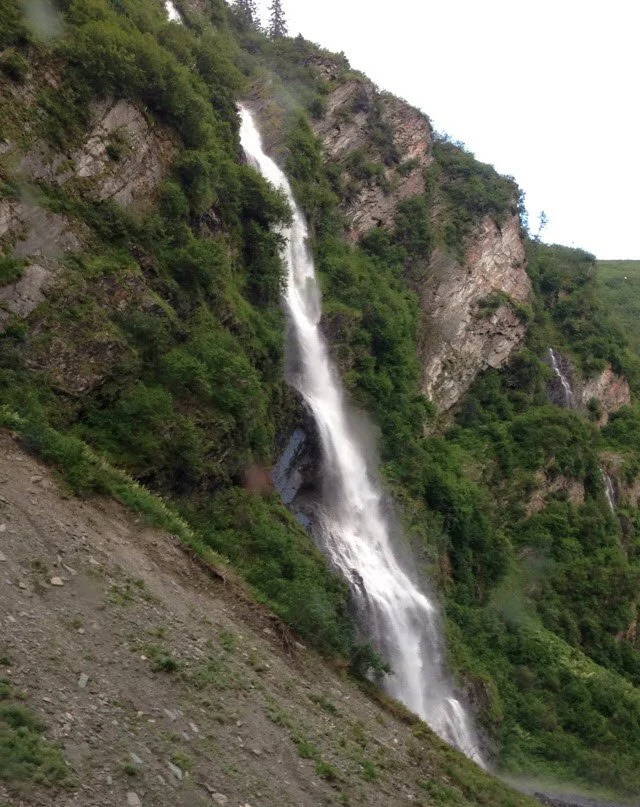
Once, I slept in the pickup truck with him, in Prudhoe Bay. And, yes, it was forty below. Outside. Which was only necessary for the bathroom and the shower in the nearby building.
I have seen glaciers. I have witnessed how they’ve receded.
I have seen flocks of ptarmigan flying across the icy road; so hard to see white birds against a white landscape. But a thrill when you do. I have a picture, somewhere.
I have been on big, wild rivers where eagles are as thick as mosquitos. I have fly fished in streams and lakes. I have fished for and eaten Arctic char. Always a fly fishing “rig” and fishing rod, or two, in the truck. Or car. You just pull over to the side of the road and catch dinner. Or just catch and release if there’s already plenty at home for dinner. You never keep the big fish you catch; that’s good stock. You let it live and pass on its hearty genes to its spawn. And you never keep a fish you don’t need. If there’s something at home for dinner, then you fish for sport and let it go.
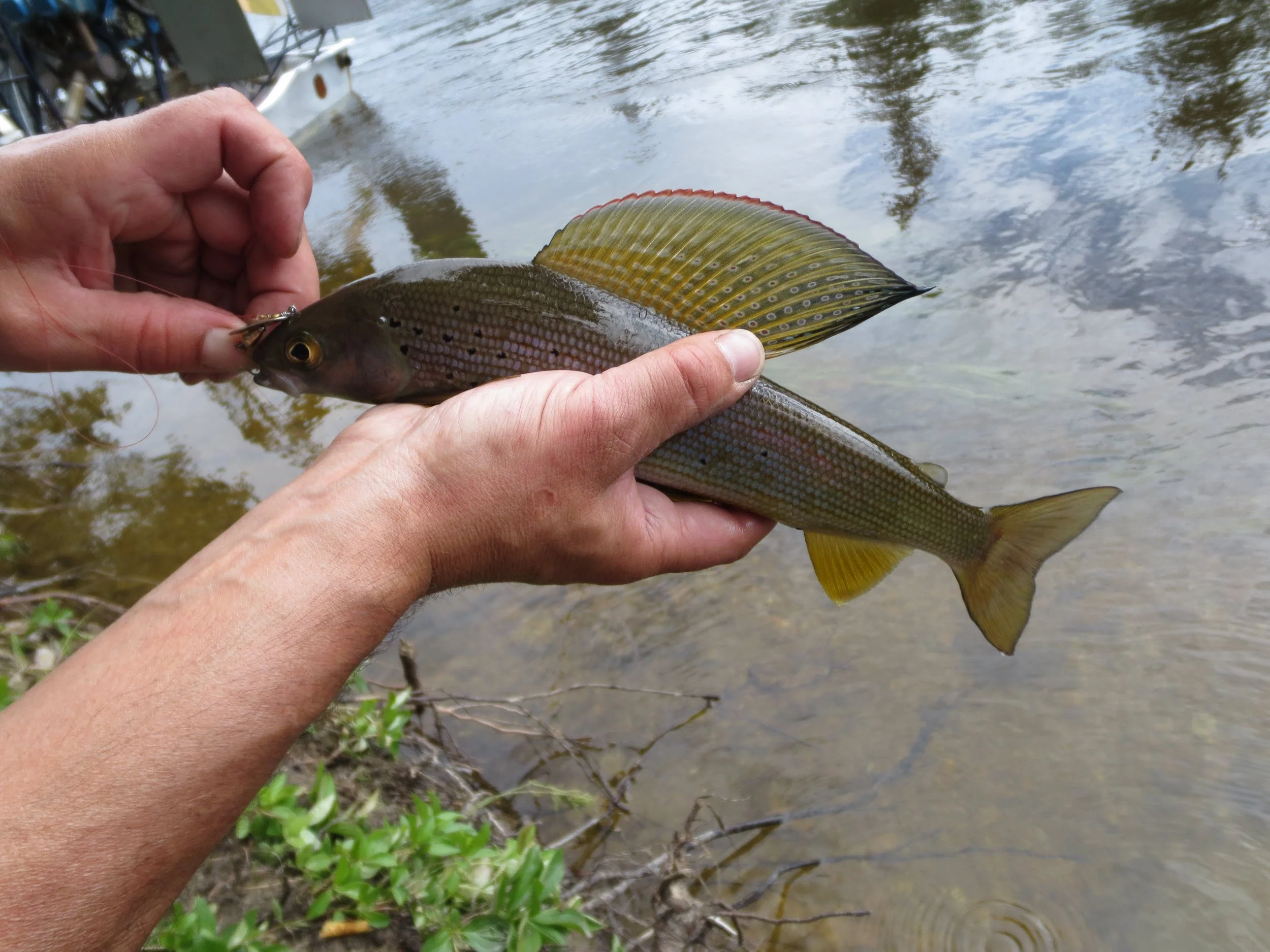
Not being a “resident” I wasn’t allowed to “dip net” for salmon on the Copper River, but I was able to help. As they were caught, sometimes two or three at a time, they were, literally, thrown to me. My job was to quickly put them out of their suffering, gut them and chop off their heads. It sounds barbaric; but this is “sustenance” living. This isn’t sport. This is food on the table for the next year. Until the next season. Assuming the salmon population is plentiful enough. Each year, sustenance fishing is allowed only if the population is robust enough. So, you catch your allotment and put it up for a rainy (or snowy) day.
I got to go moose hunting, but we came home empty handed. This, too, is for sustenance. Not sport. It is food in the freezer because you’re only allowed one moose per year and you don’t always get one. When you do, you share it with whoever helped you cut it up and carry it back to the vehicle. You share it with whoever helped you butcher it; no small job. And you freeze the rest in case you don’t get one for the next year or two.
We would sometimes head up the trail from the house on the ATV and hunt grouse. For dinner.
And the people. His friends and neighbors. The community.
The neighbors on the mountain work together to grow food and share the rewards. One family grows potatoes. When the potatoes need planting, everyone shows up. When the potatoes are ready to be dug up and harvested, everyone is there to help. And everyone goes home with some potatoes for the winter.
One family would raise pheasants, another would raise chukars; and trades would be made. When dinner rolled around, it was common to go out with the .22 and shoot on bird, defeather it, cook it and have it with potatoes and garden grown vegetables an hour later. That’s about as farm to table as it gets.
Gardens are compared and shared. His was in a greenhouse he built himself. There was an oil burning furnace inside with piping that ran under the beds so the soil could be thawed before the world outside was. The growing season is way too short to wait for things to thaw.
There is a rhythm. In Alaska, you have no choice but to live by the seasons. Of course, there is a Safeway; you can buy all the same stuff there as you can in a Safeway anywhere. But that didn’t seem to be the norm. You went to the market to fill in those couple of things you didn’t have; catsup, or cheese, or deodorant. Maybe not everyone, but I would guess that the people who live there most of their lives, who understand and are “in tune” with the seasons, who feel the connection to the abundance and absence of sunlight.
I felt that rhythm. I felt that connection. And the sense of community I experienced on that mountain. It felt right. I understood sustenance, on the delicate balance of species; humans, animals, fish. It was a way of life that I admired and could adapt to.
There were doubts, though. Not mine, mind you. The man felt something was wrong. That a California poppy could never thrive in Alaska. A pattern of doubt, break up, confidence, and make up developed. It was exhausting. After the third, fourth, maybe fifth time, I just let it go.
There was grief at what was lost. The relationship, sure, but I have another that is far more stable, over eleven years and no doubts. No heartache. The grief I experienced after the breakup was as much to do with the loss of Alaska. I belonged, at least part time. And then I didn’t. No more aurora borealis, no more walks on the tundra picking wild blueberries. No more crazy ice road trucker adventures. Someone asked me recently whether it was the man, the people, the place, the adventure, or just the edge that I was most heartbroken by. I had to really think about it. I do love an edge. I thrive on adventure. But, I have to say, it was the awe of the place; the vastness, the beauty, the power of nature there. And it was the people I met and the sense of community.
But what I think I learned from my experiences was a respect for rhythm. Light and dark. Warm and cold. Plant and harvest. Salmon are running, or they aren’t. The moose are up in the hills or they’re down low. The fish are near the surface, or closer to the bottom.
And since then, I have paid more attention to the rhythms around me; not just weather and seasons, but cycles and routines, rituals and practices. The rhythm of a day. The rhythms in our bodies; hunger, thirst, movement, sleep, mood, emotion. The more I pay attention to those cycles, those rhythms, the more I understand what my body needs, what my brain needs, my heart, and my soul. Like the chorus of a song that repeats every now and then.
Would I do it all over again? Absolutely. Would I go back? As a tourist, perhaps, to parts of Alaska I haven’t seen.
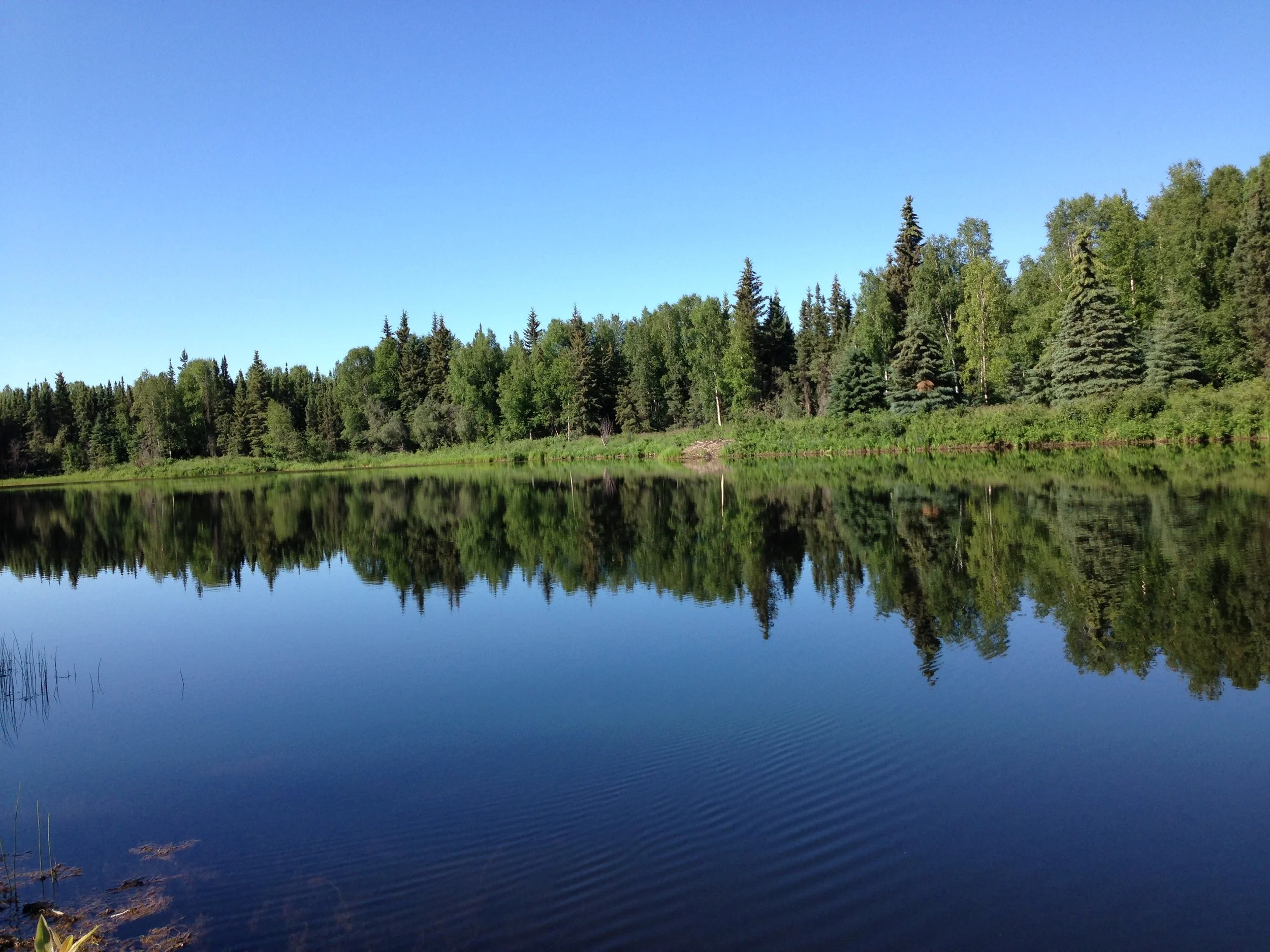
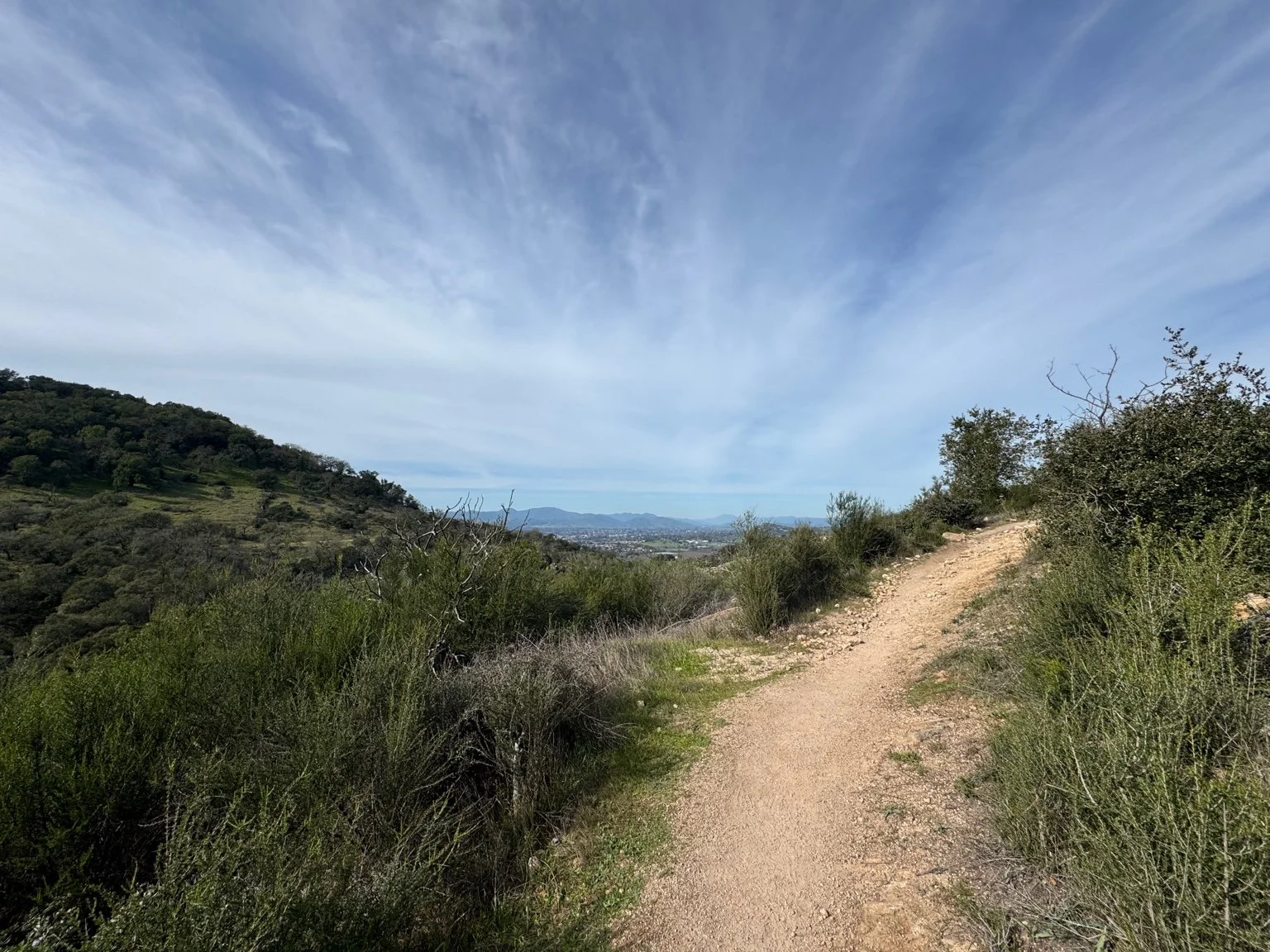
But I am in a good rhythm, here, now. I garden, now, and pay attention to the rhythm of planting, tending, and harvesting according to the seasons that surround me. I hike more during spring and summer when the weather is cooler. I walk more in the summer and winter, when hiking is less comfortable. I always put on a little extra weight in the fall and shed it in the spring. Like a bear. I’ve been experimenting with new rhythms in this postmenopausal body, too — fewer meals, narrower eating windows, more strength, less frantic cardio. Listening more closely. Adjusting when the season shifts.
Life is good, here. I have community. A good man. A cat. I have my own crows now, too. I am hoping to get one to eat from my hand.
HRV, Cortisol & Belly Fat — A Midlife Stress Spiral (and the Way Out)
Three urgent ads about HRV, cortisol, and belly fat spiked my nervous system — which felt ironic. Here’s the real connection between stress hormones, heart rate variability, and visceral fat in midlife — and how to reverse the spiral.
I was scrolling through Instagram this morning and came across three ads in a row.
The first warned me that my HRV might be dangerously low.
The second suggested cortisol was silently sabotaging my metabolism.
The third informed me that belly fat was a hormonal emergency.
Each one offered a solution.
For $297.
Each.
And for a moment — just a moment — I felt frightened.
Like I had missed something.
Like I had failed at something that needed fixing immediately.
My nervous system braced.
That’s what caught my attention.
Not the claims.
Not the price.
The activation.
Because the marketing was doing the very thing it claimed to help me avoid.
It raised my stress.
What Those Ads Were Actually Referring To
Underneath the urgency, there is real physiology.
It just doesn’t require panic.
Three things are connected:
Heart Rate Variability (HRV)
Cortisol
Visceral fat
Let’s make it simple.
HRV: Your Recovery Signal
HRV measures the variation between heartbeats.
Higher HRV = your nervous system can shift between effort and recovery.
Lower HRV = your system is spending more time in “braced” mode.
Research consistently shows that lower HRV is associated with higher metabolic risk and increased central adiposity.
In plain language?
HRV reflects how well your body can exhale.
Cortisol: Your Stress Messenger
Cortisol isn’t the villain.
It wakes you up.
Mobilizes energy.
Helps you respond to challenge.
But when cortisol remains elevated or erratic over time, it can:
Raise blood sugar
Increase insulin signaling
Encourage central fat storage
Disrupt sleep
Suppress HRV
Cortisol responds to perceived threat.
Not just trauma.
Perceived threat includes:
Sleep disruption
Alcohol
Overtraining
Caloric restriction
Noise — even the background hum of the media we invite into our homes
Constant optimization messaging
And yes… fear-based marketing
Your body does not distinguish between “serious problem” and “urgent headline.”
It responds to activation.
Visceral Fat: Protective Storage
Visceral fat is stored around the organs.
It is hormonally active and responsive to stress signaling.
Higher cortisol exposure is associated with greater central fat deposition — particularly in midlife, when estrogen declines and fat distribution naturally shifts.
Again:
Not failure.
Adaptation.
The Downward Spiral
Here’s how it unfolds:
Baseline tension
↓
Lower HRV
↓
Cortisol dysregulation
↓
Visceral fat storage
↓
Inflammation
↓
Further reduction in HRV
A feedback loop.
Quiet. Gradual. Biological.
The Upward Spiral
The spiral works both ways.
Lower baseline tension
↓
Higher HRV
↓
More stable cortisol
↓
Reduced inflammation
↓
Improved metabolic flexibility
↓
Less central fat storage
Not through urgency.
Through consistency.
Through safety.
And that’s where I landed this morning.
Not in panic.
In perspective.
Because if physiology responds to bracing…
It also responds to exhaling.
Joy = nervous system safety.
Safety = resilience.
Resilience = health span.
Health span = a life fully lived.
That’s what the ads were trying to sell.
But they skipped the safety part.
You don’t build resilience through fear.
You build it by lowering baseline tension.
By walking outside.
By lifting something heavy.
By sleeping deeply.
By eating enough.
By laughing.
By resisting the urge to treat every metric as an emergency.
The ads stressed me out.
And then they reminded me.
Safety first.
🌿
If this perspective resonates with you, this is the kind of conversation we continue inside Whole Woman Joy Circle — a space where joy-led practices support nervous system safety, resilience, and health span.
No panic.
No urgency.
Just steady, grounded growth.
You can learn more here → [link]
Sauerkraut
On resistance, good stress, and learning to trust yourself.
And also about the quiet power of doing hard things—long enough for them to become joyful.
I honestly don’t remember the first time I ate sauerkraut. It’s entirely possible I managed to avoid it until I decided to eat it intentionally.
I do remember that in my mom’s rotating, standard dinner fare, one meal included sauerkraut—one I was not made to eat. It may have been Thursdays. Pork chops, mashed potatoes, applesauce, and a small iceberg lettuce salad with Italian Seasons packaged dressing. The kind that came with a carafe marked with lines so you knew exactly how much oil, vinegar, and water to add. It was always my job to make the salad dressing.
Mind you, my parents were both raised during the Depression era, and you ate what you were served. Or else. Perhaps they were wise enough not to serve me sauerkraut. It smelled awful. I was quite happy with the arrangement.
I don’t think I encountered sauerkraut again until I was well into adulthood and had kids of my own. My daughter was in a youth group for girls, and each year they raised funds by running a snack bar at a large, annual model railroad fair—well attended by older, white, middle-aged men who loved hot dogs, potato chips, and sauerkraut.
I may have missed my calling. I’ve been an accountant much longer than I ever planned. Not that I planned it at all. I think I should have been in marketing. I just get ideas. They pop into my head and tumble out of my mouth before I even know what hit me.
The best-selling item at our snack bar was a hot dog smothered in chili and topped with sauerkraut. The menu called it something lame, like Hot Dog with Chili and Sauerkraut. This was a fair attended by train freaks! Why weren’t we calling it a Train Wreck? Right? Genius. I admit it.
At this fair, every year, there was a new girl in the group. It was tradition—believe it or not, not one I inspired—that the “new girl” had to take a bite of sauerkraut. If she didn’t immediately spit it out, but actually swallowed it, well… she was “cool.” Or whatever.
Sounds like hazing, doesn’t it? Now that we’re all trauma-informed, I feel a little guilty about any part I may have played in that. Except for naming the Train Wreck.
Two decades later, I had still managed not to eat sauerkraut.
I knew all the amazing health benefits. I would brew and drink gallons of kombucha. And kefir. I ate tubs of plain, bacteria-rich yogurt. I spent more than I should on my daily probiotic supplement.
Then I read a book.
Actually, I take that back. I followed a new and mildly annoying habit of mine: I bought the book, listened to the audiobook, and then—because it was that good—I read it after listening to it.
Good Stress by Jeff Krasno.
As Jeff would say, I bought a “dusty old scroll,” but I also enjoyed the lilt of his voice. Highly recommend.
There were several “good stressors” in the book that I swore—swore—I would never do. Let me age too fast and die too young! I will never:
take a cold shower
eat sauerkraut for breakfast
Both of which Jeff does, recommends, and swears by.
Nope.
Not a chance.
So… let me tell you how that’s going.
Two of my favorite parts of my morning routine now include finishing my very hot shower with two minutes of ice-cold water. On the days I skip it, I feel incomplete. Out of sorts. Not quite right.
And the first bite of my breakfast?
A cold, slimy, stinky hunk of sauerkraut.
But it is—
I can’t believe I’m saying this—
delicious.
Of course, I had to experiment. Please note: while cold showers are close to free, quality, organic kraut most definitely is not.
I’ve sampled flavors. Plain cabbage kraut—the one I most associate with my lifelong avoidance—still isn’t my cup of tea. Last week’s jar was golden beet kraut, and it was pretty good. This week, I’m working through a kraut made from seven kinds of carrots, and it’s excellent. Next week, another fifteen-dollar jar of craft kraut awaits.
You may be asking yourself: why?
Well, beyond all the reasons Jeff Krasno lays out so clearly, there’s this:
Sometimes the satisfaction of doing hard things—things you resist, but know are good for you, scientifically proven good for you—and integrating them so fully into your life that things feel off when you don’t do them…
That gives you hope.
And self-efficacy.
I can do things that are good for me that I never thought I would do.
That opens a door.
Maybe several doors.
If I can take a cold shower and eat sauerkraut for breakfast, maybe I can go to the gym twice a week. Maybe I can walk after dinner. Maybe I can do a five-minute mobility routine before lunch.
Maybe I can replace soda with sparkling water. Sugary snacks with fruit. Wine with herbal tea. Cocktails with mocktails.
Maybe I can change the numbers on my midlife lab report. Maybe I can change the numbers on my DEXA scan—or at least keep them stable. Maybe I can live independently, longer.
Or maybe—just maybe—like Jeff Krasno dreams in his book, my healthspan and lifespan will end on the same day, at 120 years old, asleep beside the person I love, after a hike and a home-prepared meal… and yes, an exquisite bottle of wine saved for a truly special occasion.
If you’re in a season of life where you’re trying to make small, meaningful changes—without shame, perfection, or punishment—this is the kind of conversation we’re having inside Whole Woman Joy Circle.
We talk about joy not as indulgence, but as a practice. As a form of resilience. As nourishment.
If that feels familiar, you’re welcome to come sit with us
Explore Whole Woman Joy Circle
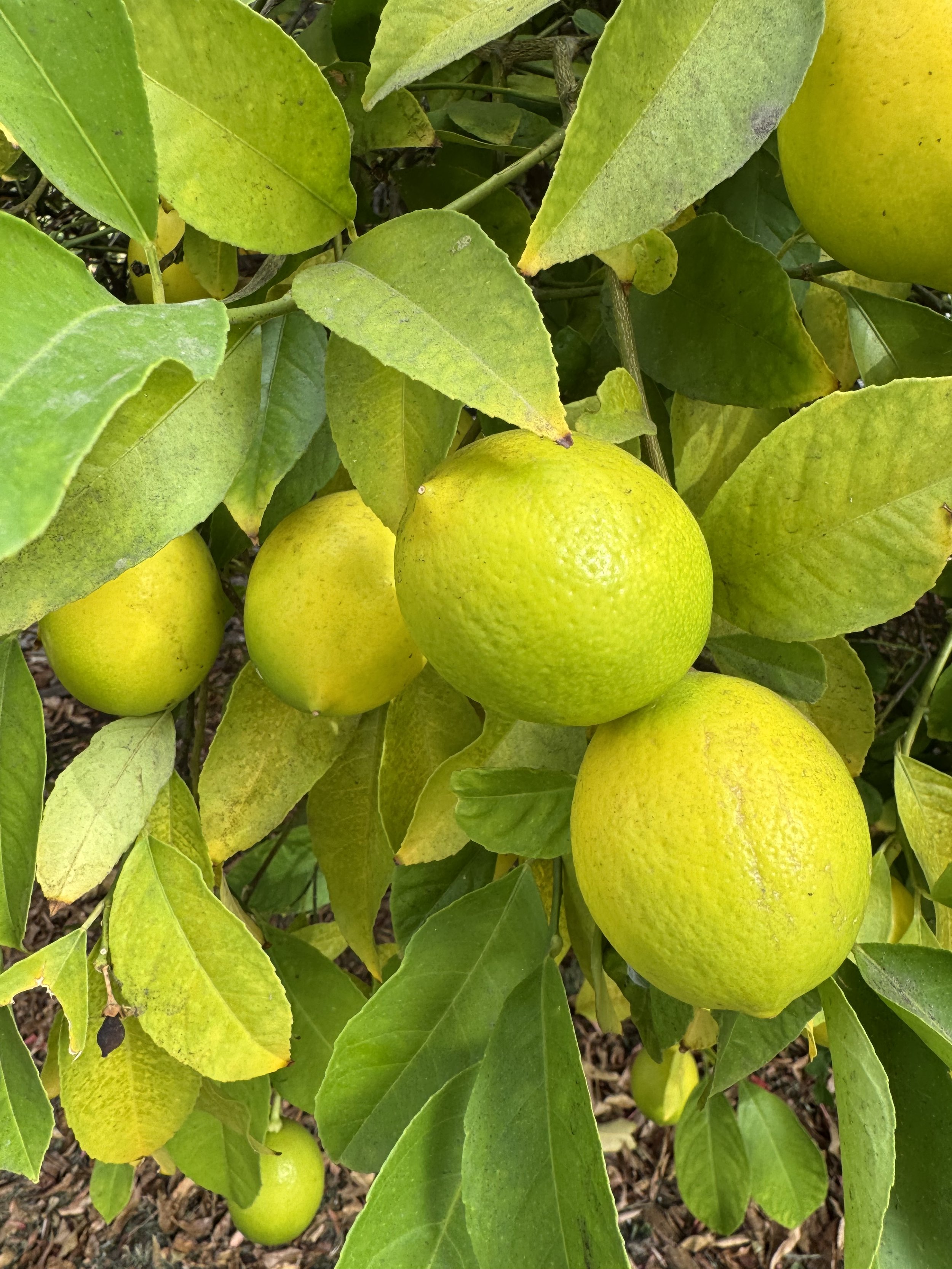
The Lemon Tree: Limoncello, Lemon Blossoms & Everyday Magic
A Meyer lemon tree. A half wine barrel. Limoncello in Christmas stockings. Lemon bars, neighborhood magic, and the scent of blossoms drifting through open windows on warm evenings. A story about love, memory, and the everyday kind of joy that grows right outside the front door.
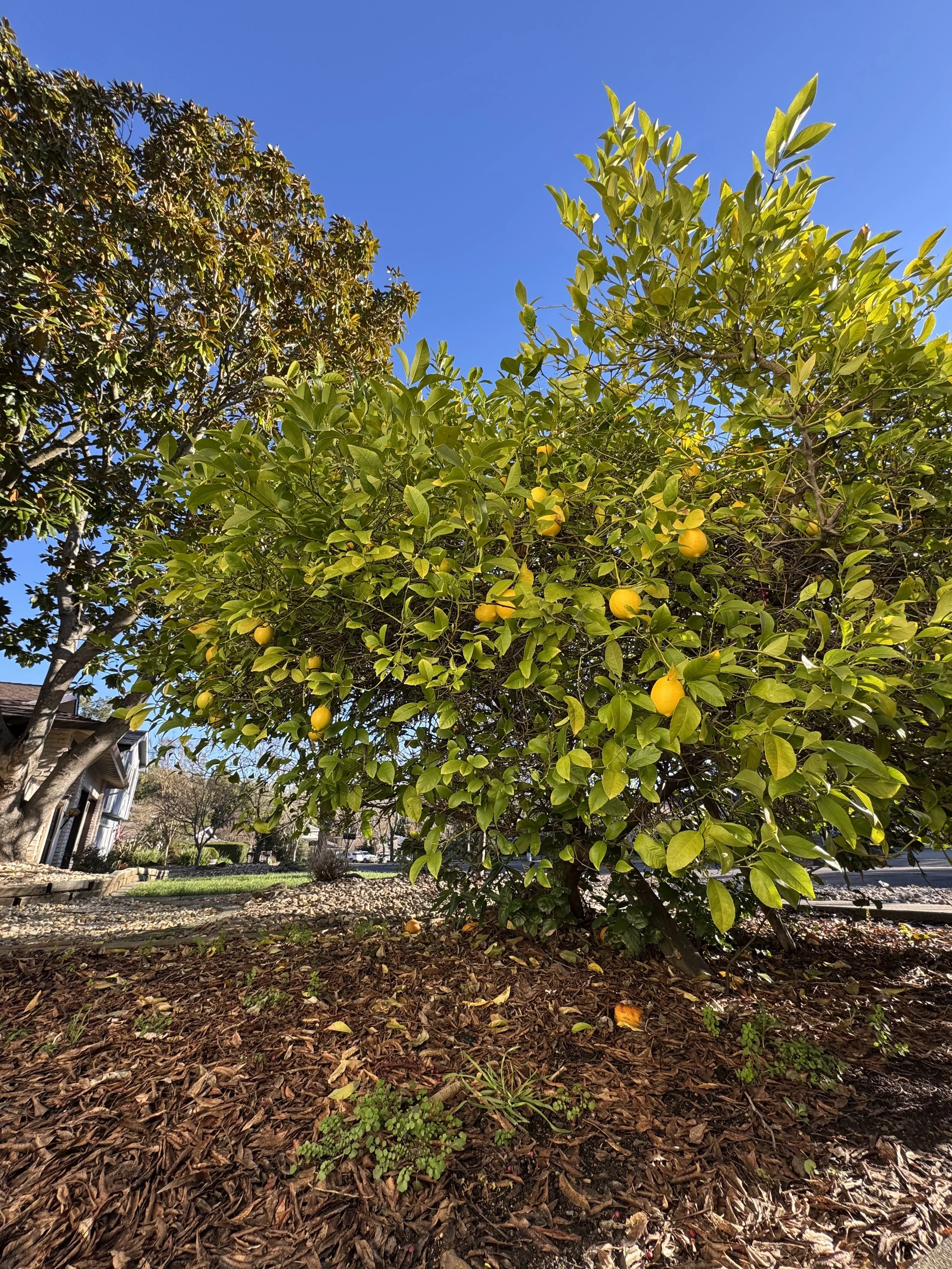
The lemon tree that outlived barrels, winters, and everything we thought it couldn’t.
A long time ago, a Meyer lemon tree was planted in a half wine barrel in the front yard of the house I grew up in.
I don’t remember exactly when it appeared — sometime after I’d left home and moved to another city about an hour away. The tiny lemon tree filled a space alongside the driveway where there had once been a patch of fussy lawn and a messy tree: never to my dad’s liking (he was all about the perfect lawn), and never to my mom’s liking either, because my mom detested messy trees — no matter how beautiful their fall leaves might be.
The lemon tree was centered in the half wine barrel — a favorite planting container in this household. The barrel was centered in the driveway bed, surrounded by very pedestrian, suburban-chic cedar bark.
And for a long time, I didn’t pay much attention to it.
The tree became part of my life, I suppose, when it began to bear fruit. Plentifully.
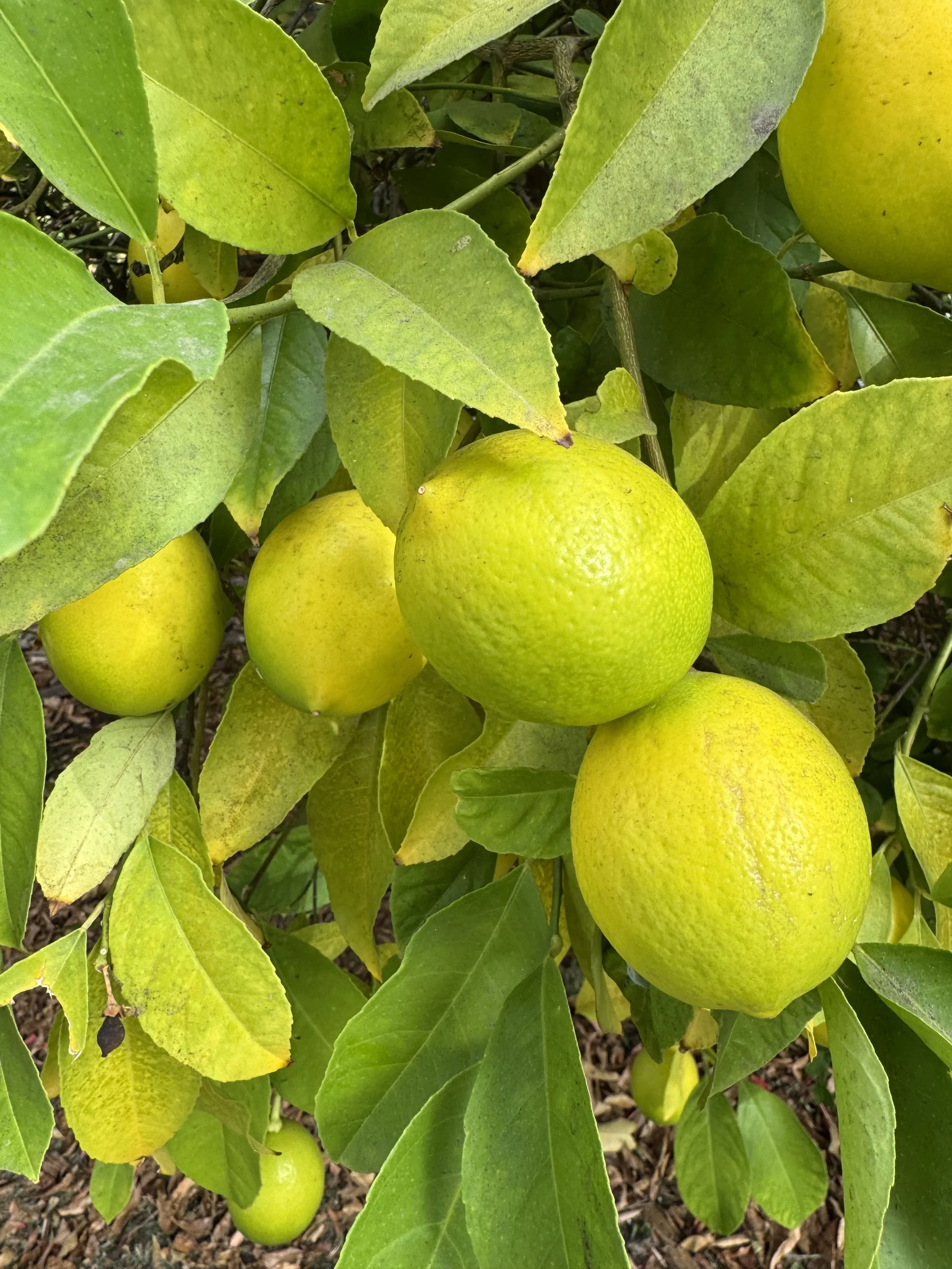
Sweet, sunlit Meyer lemons.
Somewhere along the line, with a whole bunch of Meyer lemons on their hands, my mom and dad decided to make limoncello. I don’t remember them having, serving, or even liking limoncello before this. But the tree was prolific, and they already had enough frozen Meyer lemon juice cubes to last years.
I remember their first batch. They used a recipe — Martha Stewart’s, I believe — and it called for 100 proof Everclear, which wasn’t available in California. So my parents drove all the way to Nevada to buy it.
That batch was made, and then for the next year, every time we visited, dessert was ice cream with limoncello poured over it.
The next year, they made it again — but from a new recipe. Giada’s, if I remember correctly. This one didn’t require crossing state lines; it called for ordinary vodka, available by the handle at Costco. Which still required a drive to a neighboring city, but not a neighboring state.
By now the lemon tree had become outrageously prolific, and limoncello became a kind of family currency. Every Christmas, bottles of homemade limoncello appeared in our stockings. And on other occasions, too.
The neighbors received bottles for the holidays. Friends and relatives did too. The gardener my parents hired after my dad was no longer hardy enough to mow all the lawns anymore — he got a bottle. I’m pretty sure the mailman got one. And the banker. And the tax preparer.
There are, in fact, still a couple of bottles of homemade limoncello, carefully labeled in my mom’s cursive handwriting, rattling around in the freezer.
She has been dead for over nine years now.
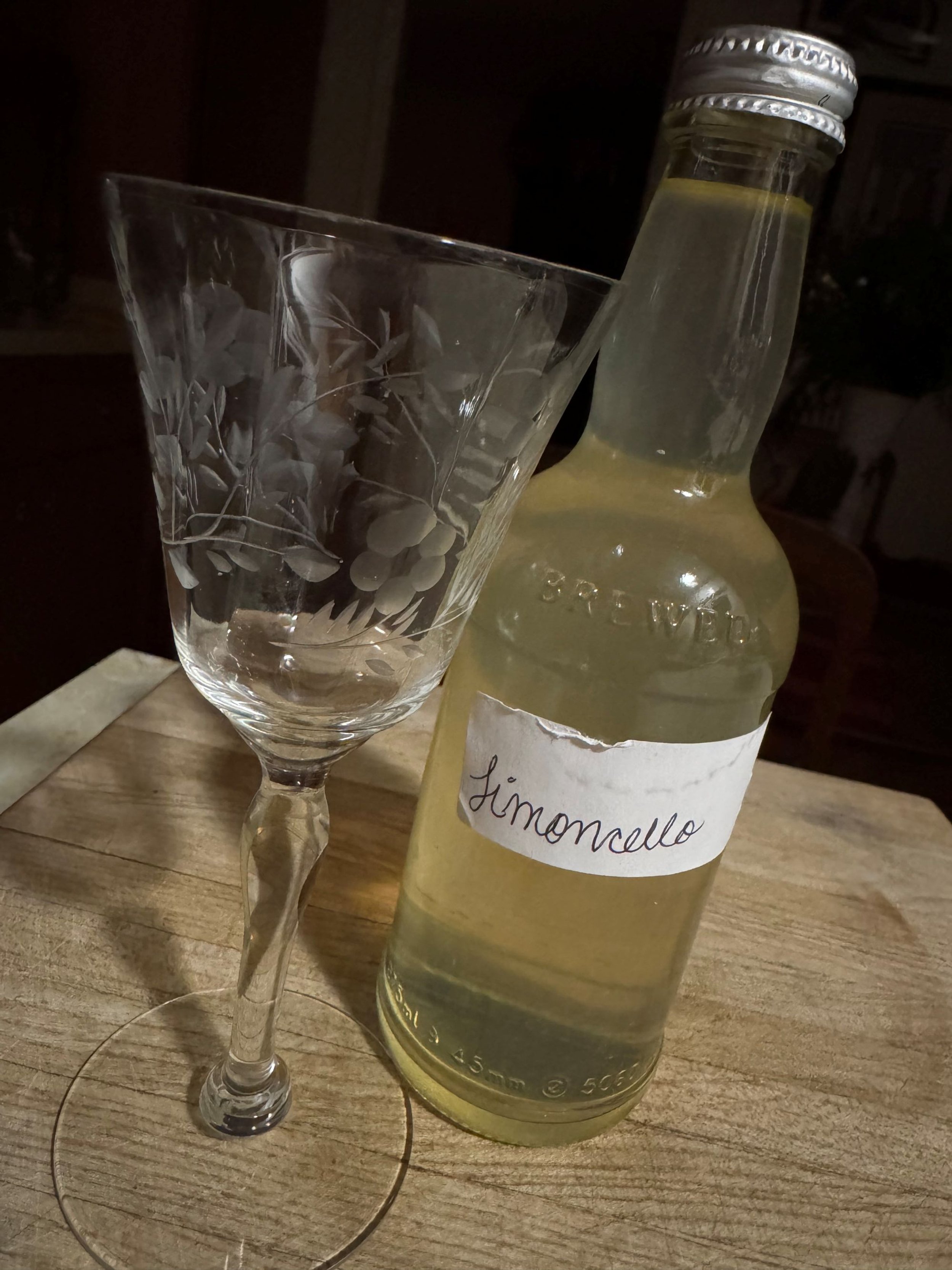
Winnie’s limoncello: still rattling around in the freezer.
And then there were the lemon bars — with Meyer lemon curd. They were served almost as frequently as the limoncello. Any time my mom needed to bring a dish somewhere, she brought dessert: lemon bars.
My mom was a nurse — she became an R.N. through the Army Corps of Nurses during World War II and graduated just as the war ended. She worked as a nurse for most of my childhood, from grade school on, and she had a remedy for everything. If you had so much as a sniffle or a scratchy throat, her first and fastest line of defense was a hot toddy — a non-alcoholic one during childhood, and a much different one for grown-ups. Hot water, a spoonful of honey, whiskey if you were of age, and most importantly: Meyer lemon juice. Fresh from the tree if it was in season, or an ice cube from the last crop if it wasn’t. To this day, it’s still my first line of defense when anyone in our household is feeling peaked.
Even neighbors who weren’t on the official limoncello list loved the lemon tree. The fruit was incredibly sweet — truly the best Meyer lemons I’d ever tasted. People would walk by and ask if they could pick a few for a recipe. The little girls next door would pick some (with permission) and make lemonade to sell. We got lemonade for free.
There were always too many lemons.
Bushels of them left long after “lemon season.” And they were impossible to reach without thorns tearing at your clothes and leaving you scratched and bloody. Over time, the tree grew so large it became impossible to reach the center even with your arm fully outstretched, even when you thought you were being careful.
My parents cared for that lemon tree the way many people would care for a beloved pet. Or even a child. They pruned it, fertilized it, fed it — and it grew and grew and grew. Much larger than any pet. Or child.
It eventually overtook the entire side of the driveway.
When the temperature threatened to dip below freezing, my parents — well into their eighties — would drag out ladders, old bed sheets, and wooden clothespins to cover the tree. The next day, they’d uncover it so it could get sun. And then cover it again before nightfall if it was going to be cold.
This practice went on for years.
After my dad passed away, my mom — now in her late eighties — struggled to cover the tree on her own. And (perhaps due to the gallons of limoncello shared over the years), a delightful lesbian couple down the street began helping her, covering and uncovering the lemon tree to protect it from frost.
The only trouble was: they’d cover it and leave it covered for days, until the general weather pattern warmed. My mom was incredibly grateful, but she fretted about it. When I visited — which I was doing more often after my dad’s passing — I sometimes had to go uncover it, then cover it again before heading home.
It was quite a chore: ladders and multiple sheets and so many clothespins.
It seemed like a lot of trouble for a few bottles of limoncello. Unless you really, really loved limoncello.
Soon after my dad’s passing, the tree escaped its half wine barrel. The wood had rotted until the barrel was nothing more than a few old slats and metal rings. The root ball sat partially exposed atop the ground, and without stable footing, the tree toppled lazily over — not breaking, not uprooting completely, just listing onto the sidewalk.
The gardener told us, regretfully, that the tree would certainly die.
But again, the neighborhood came to the rescue. The lovely gentleman across the street and his next door neighbor came over and managed to prop it up using a two-by-four carefully placed under a branch at an angle.
The tree never showed any distress. It continued producing sweet lemons as prolifically as ever.
Not long after, I moved back home. My mom was in her nineties and needed someone close. She needed help with the house, and company — and yes, help with the lemon tree.
The neighbor ladies eventually retired and moved away, and no one stepped in to manage frost duty anymore. It became my chore.
And I resisted.
I was convinced the tree would survive the cold, even freezing temperatures — and would outlive us all. I worked full-time and traveled often; it didn’t feel practical to race out with sheets and ladders at sundown.
After everything the tree had survived, I figured: whatever happens, happens.
The tree stayed naked for an entire winter. Freezing temperatures and all.
It was fine.
It continued producing lemons at an overwhelming rate.
By then, I had moved back into my old bedroom in my childhood home — a mid-century house my parents bought brand new in the northern part of the San Francisco Bay Area.
We don’t have air conditioning. We don’t really need it. Many newer houses do, and plenty of remodeled houses have installed it. I could have.
But I passed.
Because when the weather is warm, I open the windows. And what people with air conditioning miss is this: the absolutely magical scent of lemon blossoms riding the gentle evening breeze up and into the house.
I cannot imagine a fragrance more magical than Meyer lemon blossoms.
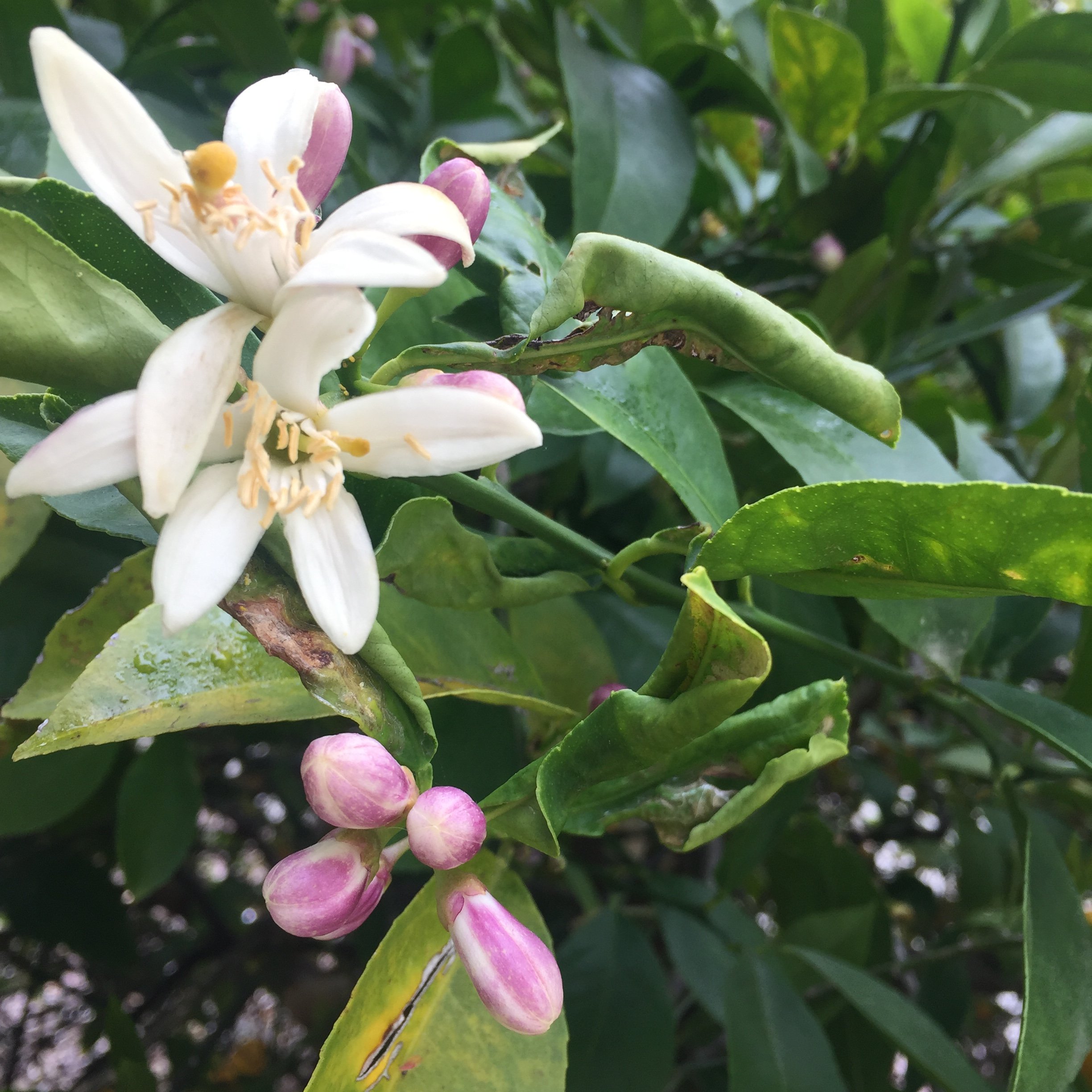
Lemon blossom magic.
My mom passed away a few years later at the tender age of ninety-two.
I inherited the house, the lemon tree, and the gardener. The gardener makes limoncello every year, and I get a bottle or two to add to my freezer collection. I have more than a lifetime supply by now.
I live here now with my partner, Neil. He works in hospitality and restaurant management, and sometimes he harvests a five-gallon bucket of Meyer lemons to share with the chef and bartender for whatever they dream up.
The neighbors still pick lemons at will. I use at least one lemon a day for various recipes and concoctions.
And one day last year, I was out near the lemon tree when I saw something move quickly in the next door neighbor’s yard. We live along a creek and often have deer and other wildlife browsing in our neighborhood. I assumed it was a deer — but when I stepped around the lemon tree to see, it was a little girl.
Tiny as a fawn. And about as shy.
She was backing away toward her house, clutching lemons like treasure. Then her mom stepped out, smiling sheepishly, and explained that the neighbor between us had given them permission to pick lemons for a cookie recipe.
I greeted them and assured them it was absolutely fine — and that we’d be grateful if they picked as many lemons as they could possibly use.
I did not receive any lemon cookies… but I am not actually keeping score.
This story ran through my mind this morning as I stepped out into the very cold air — near freezing, I believe — and walked out to the massive lemon tree to pick a big, plump, bright yellow lemon for my morning matcha tonic.
This tree is a marvel.
It is a gift.
It is magic.
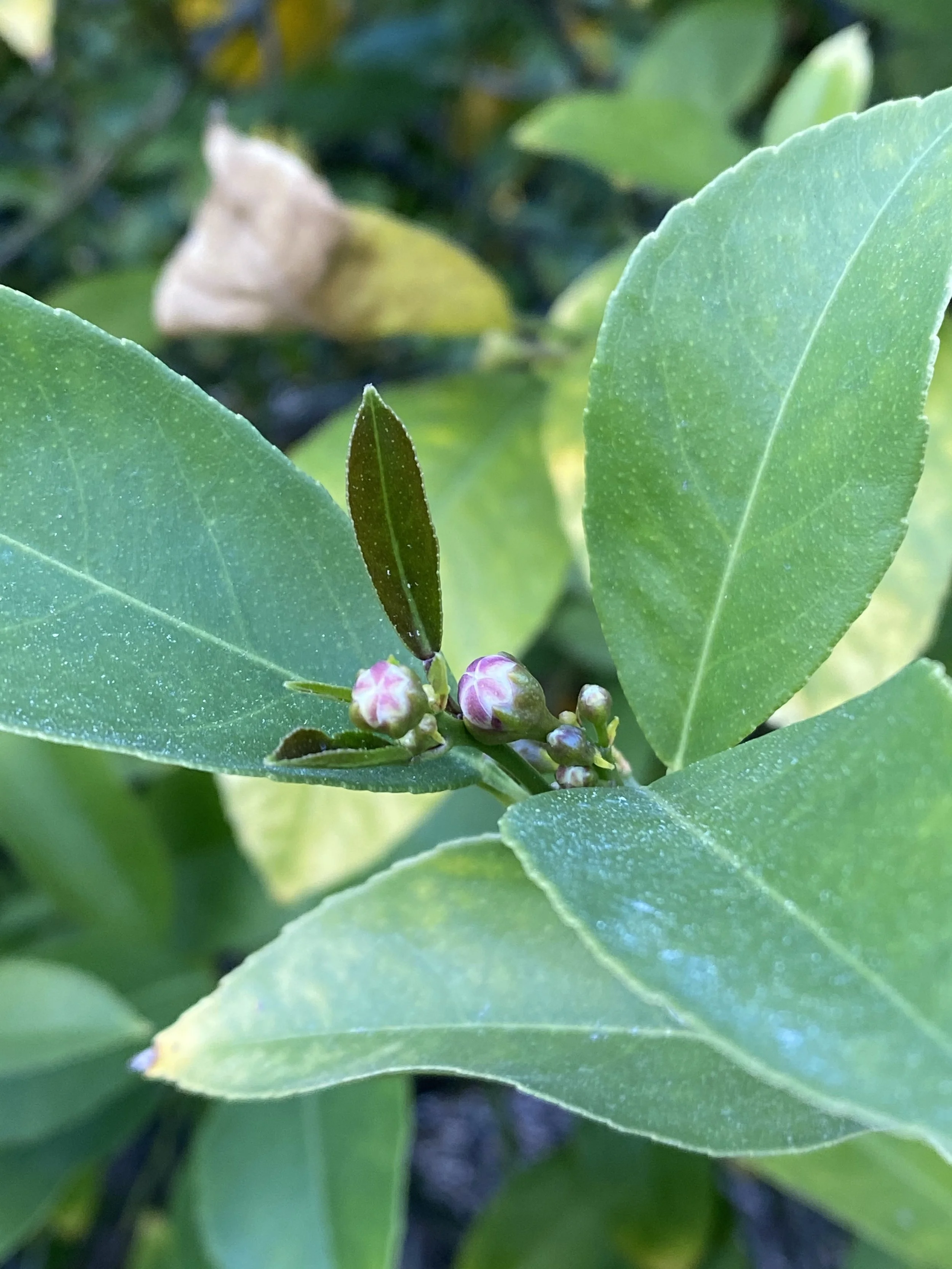
Spring, loading…
And somehow, it still belongs to my parents… and this house… and this neighborhood… and to everyone who has a bottle of Winnie’s limoncello rattling around in their freezer.
Joy
I grew up an only child. I wished for a sister—I would have accepted a brother—but neither came into my life. My parents had both been married before, divorcing and eventually finding each other. I was a “late-in-life” baby; my mom was thirty-nine when she had me in the early 1960s. Her doctor discouraged her from having another child because of the potential risks to both mother and baby.
So the wish for a sister endured, well past childhood, into adulthood, and even into the years when I helped care for my parents near the end of their lives—a responsibility I carried stoically, without regret, resentment, or anger, and alone. Later still, I understood that a sister might have been someone with whom to share the grief of losing my parents—the inevitable and indelible.
When I was in elementary school, I came across a photograph of a little girl tucked into a shoebox in the garage. It was sepia-toned, and the girl had blond ringlet curls. I was curious and enchanted.
I asked my mom about the picture, and she told me it was my dad’s daughter from his first marriage. Her name was Joy. My mom explained that Joy would be quite a bit older than me, and that my dad didn’t know where she was or what had become of her. He hadn’t seen her since leaving for England to serve in World War II.
I remained curious. There was a sister out there somewhere—someone who shared something deeply personal and uniquely mine. I stayed enchanted and thought of Joy often for the next half century.
As I grew older, my mom shared more of what she knew about Joy’s story. My dad didn’t speak of it at all; he was a quiet, private, reserved, and deeply stoic man. I’ve learned more about him since his passing than I ever did during his life—despite having considered us fairly close as father and daughter.
My dad married young, and Joy was born just as he enlisted in the U.S. Army Air Force as an instrument mechanic on the B-24 Liberator. He served in England, leaving his wife and daughter behind. When he returned, his wife had developed a relationship with my dad’s best friend. In one sweep, the marriage, the friendship, and his fatherhood all ended.
My dad knew that I was aware of Joy and her story. And I knew that he always hoped Joy would want to meet him—to reunite, to talk, to develop some kind of relationship.
Several years before my dad passed away, he received a letter from Joy. She had two grown sons, and one of them had developed cardiovascular disease. Her stepfather had passed away, and she now knew that my father was her biological father. She wanted information—but not a relationship.
They spoke on the phone once, just long enough to fill in some of the details of my father’s health history. She asked whether he had any other children. When he told Joy about me, and my age, she scoffed; I was younger than her own children. She was clear—unmistakably so—about not wanting to meet my dad, her dad, or me.
My dad was heartbroken again. Still. And that was hard for me to witness, to carry, to know. I couldn’t understand not wanting to meet, to connect, to learn, to share.
When my father passed away, we held a small family gathering at the veterans’ memorial cemetery, followed by a meal at a nearby restaurant. My cousins were there—all older than me, and all much closer to Joy’s age than mine. They had actually grown up with Joy in early childhood. For a time, Joy’s mom—my dad’s first wife—lived on the same block as my grandmother, aunts, and cousins. They shared birthday parties together.
At my dad’s memorial service, my oldest cousin, Altha, came up to me. She looked at me solemnly and said, “I hope you’ll find joy.” I smiled and replied, “Oh, Altha, you too.” She gave me a strange look but said nothing more.
Later, when the service was over and my mom and I were in the car heading home, it occurred to me: Altha had meant Joy the person, not joy the feeling. I shared this realization with my mom, but she discouraged the idea. Joy didn’t want to be found—not by my dad, and not by me. I accepted that, and my curiosity and enchantment with the idea of having a sister evaporated.
Still, tongue in cheek, I began taking pictures of the word joy whenever I came across it, announcing to no one in particular, “I found joy today.”
After my dad’s passing, I did find a path toward living a healthier lifestyle. I became more physically active and began paying closer attention to nutrition, mindfulness, and stress management. What followed was a personal health revolution—moving from being fifty pounds overweight and sedentary to feeling healthy, fit, and strong, capable of running marathons and climbing mountains. I felt well physically, mentally, emotionally, and spiritually.
I began reading everything I could about health and wellness, seeking knowledge wherever I could find it. Along the way, I started to notice something else: a sense of ease, calm, warmth, contentment. I felt it when I ran, when I hiked, when I spent time in nature, and when I was with friends and family. Preparing and eating nourishing, beautifully prepared food brought the same feeling. So did spending time with my cat. Gardening. Sitting in my backyard in the sunshine, listening to birds. Watching trees sway in the breeze outside my window.
Soon, I realized what this was. I was feeling joy. Not an overwhelming sense of happiness, but something quieter—subtle, soothing, kind. Joy didn’t announce itself. It whispered. It tip-toed.
I found joy in those quick, quiet moments in the in-between.
After my mom’s passing, I had the opportunity to step back from my long and demanding career in accounting. It was a career that had been good to me—something I was skilled at—but never something I had wanted to do “when I grew up.” I left corporate America.
Around that time, my daughter was exploring online college degree programs and stumbled upon a bachelor’s degree in health sciences through Arizona State University. She thought I’d enjoy it. I enrolled immediately. Because I already held a bachelor’s degree, I needed only the upper-division coursework to complete the program.
A few years later, I graduated summa cum laude and passed the national board certification for health and wellness coaches. I was finally doing something I felt deeply engaged with—something I was passionate about. Something that helped me better understand joy.
During college, to offset expenses, I started a small bookkeeping practice, putting my accounting skills to work until I could graduate and pursue a career in something I was truly passionate about: health and wellness. Juggling school, my business, and life was stressful.
I had no time for fitness—no time to work out at the gym, to run, to hike, to meditate, or to prepare nourishing meals. My sleep suffered. My mood suffered. My body suffered. Around this same time, perimenopause became impossible to ignore. Hot flashes, weight gain, and weight redistribution followed; I began carrying weight in places I never had before. My strength declined, and my balance was compromised.
And yet, I was still adventurous. I fell while roller skating and broke my elbow in two places. I fell while hiking and sprained my ankle. I fell while snowboarding and broke my other ankle. These weren’t accidents born of passivity—I was living fully, moving boldly, playing hard.
After multiple fractures, my doctor ordered a DEXA scan and diagnosed osteopenia. It was the first clear signal that I had entered a different chapter—one where pushing harder and powering through were no longer sustainable strategies.
Midlife was asking something different of me. Not less movement, but wiser movement. Not less ambition, but deeper alignment. Not less joy—but more of it, practiced intentionally.
And still, underneath it all, joy was there. Quieter now, perhaps—but steady. A calming, soothing undercurrent I could return to if I paused long enough to notice it. And I did.
But the years kept passing, and I kept on bookkeeping. It was what I did to make money. And I hated it. Hate is a strong word; I resented it. I felt trapped, and I didn’t know how to escape.
I worked longer hours for myself in a business I had created as a way out of the time and location constraints of corporate America. Instead, I found myself more constrained than ever. I was as trapped as I had been before—perhaps more so.
And somewhere along the way, joy began to slip away.
A couple of years ago, a few things came into focus at once.
I realized that I was sacrificing nearly everything I believed in: work–life balance, health, well-being, and the opportunity to build a career that aligned with my values. Freedom. Joy. Connection. Integrity.
So I decided to rescue myself. I made a plan to downsize my bookkeeping business and simplify my workload and responsibilities. I committed to building a new business centered on health and wellness coaching—and to reclaiming my health, my well-being, and my joy along the way.
I started at the beginning and reexamined everything—my values, my strengths, my personality, and the ways I move through the world. I began, again, to pay attention to my body and what it required to feel well and supported: sleep, stress management, mindfulness, creativity, joyful movement, play, nourishment, connection, and relationships, all held within an environment that could sustain them.
And once more, I began to notice the small joys woven into everyday life. I learned to linger a little longer—to relish, to savor, to recognize those moments and let them matter.
And so I keep returning to joy—not as something to chase or achieve, but as something to notice. Still quick. Still quiet. Still living in the in-between.
What else happened?
I received a letter in the mail—hand addressed, from a name I didn’t recognize. Inside was a note and a tiny bracelet. The bracelet was blue and white, small and worn with time. On the white beads, in black letters, was my last name: Fleury.
The letter was from a man who explained that he was Joy’s son—my nephew—and that Joy, my half-sister, had recently passed away. While going through her belongings, he had found the bracelet and felt I should have it. He knew the story too, though with a few variations—told from another point of view, shaped by another life. He offered to answer any questions if I wanted to reach out.
Of course I did. We connected. We shared stories. We became family. He is four years older than me. Through him, I learned more about Joy—the person—and more about joy itself.
Joy is simple. And joy is complicated. Joy lives and breathes in every moment, yet it can be elusive if we don’t give it the space it requires.
When we open ourselves to the joy around us, something shifts. Time softens. A single moment separates itself from the rest of the day and nourishes us, fuels us, reminds us that we are alive. And when we share those moments with others, they multiply—creating connection, meaning, and compassion.
Joy isn’t a cure. It isn’t something we achieve or accomplish. It isn’t the end, or even the means to an end. Though it’s often mistaken for happiness, cheer, or glee, joy is something else entirely. It doesn’t erase pain, loss, or grief—it lives alongside them. It lives alongside everything else in our lives.
This is how I have come to know joy: quick and quiet, steady and kind, waiting for us in the in-between. Especially in midlife, and beyond, joy becomes a practice—one that helps us live our messy, complicated lives with greater wholeness, presence, care, and grace.
Joy goes on. This story will too.