The Story of Keys: What Opens, What Doesn’t, and What We Carry
It’s a relic. I don’t know how it came into my family, but for me, it has always been there. My dad’s old, solid oak, roll top desk, manufactured a very long time ago by H. S. Crocker (founded in San Francisco in 1880, and, yes, related to the banking and railroad Crockers). There is a key; an old skeleton key. Just one. And when you roll down the top, the desk locks the top and all of the drawers. It is a pretty cool engineering marvel.
My dad didn’t work from home. He was a travelling salesman for Schwinn Bicycles for the early part of my childhood and owned a Schwinn Bicycle shop from the time I was about eight years old, clear through college and until he retired. But, he had this desk at home. It had his things in it, I discovered after both of my parents passed away; a slide rule, a couple of “wheels” to calculate mark up and compound interest, the sales brochure to the house I grew up in, including his mathematical equations to figure out the monthly mortgage payments. Artifacts.
For most of my childhood, my dad smoked cigars. He smoked in the house, in the car, in the bike shop, and, apparently, though I can never actually remember him sitting at his roll top desk, he smoked there, too. I know this because every now and then, the desk smells like cigar smoke. Not in the “cough, cough, ew” sense, but in the “Hi Dad” kind of way.
After my dad passed away, the desk became my mom’s. She sat there and wrote out checks to pay the bills. She kept a checkbooks ledger and a separate spiral bound, college ruled, notebook ledger, of the checks she wrote, month after month. Upon her passing, I discovered that this careful attention to detail dated several decades, predating my own creation.
The desk is mine now. It is decorated with my things, the drawers full of my things. But, some of those cool, secret cubby holes and compartments? My dad’s slide rule and calculation wheels are tucked there, just like he left them. I also have Mom’s last spiral bound notebook ledger. I don’t know why, it’s been ten years, I don’t think any bills went unpaid. But it lives in one of the super deep drawers and I really have no intention of shredding it like I did the other 50 years worth. A relic, an artifact, and continuity.
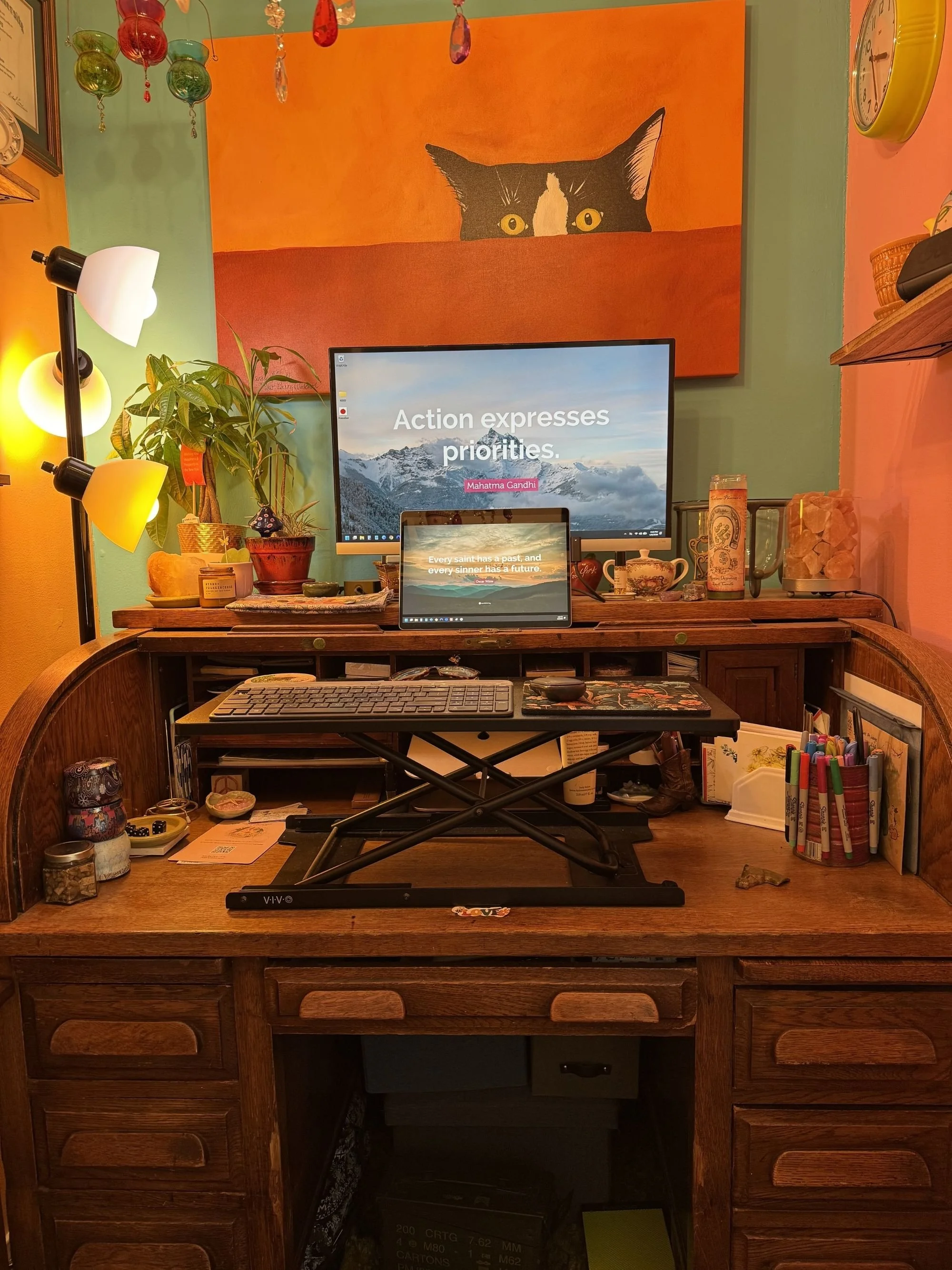
The desk is horrific to dust; all those cubby holes and little shelves. The roll top portion of the desk is ridged, which makes it especially hard to dust. And, of course, my things. Being a bit of a maximalist, there are quite a few things to move. And to dust. The desk, obviously, predates computers by several decades, but now holds an oversized monitor, a docking station for my PC, a “stand up desk” assembly, and all the other accouterments of modern desks. All of which must be moved, removed, disassembled, dusted, and then put back.
Dusting, generally, is my least favorite chore. I love cleaning. Just not dusting.
Especially “the desk”.
But, every now and then, the layer of dust gets the better of me and I stop everything to dust.
That is exactly what happened on one particular day. I decided to dust, and as long as I was at it, knowing it would be a good long time before I dusted again, I decided to do a really thorough job. What my mom would have called “damp dusting”; a damp cloth to remove the dirt, and a dry cloth, maybe with a little oil on it to dry and polish.
I usually keep the one, singular, remaining key in the lock itself. I went to dust the ridged roll top part of the desk, so I removed the key and placed it on the desk, rolled the top part way down and started dusting. Someone asked me a question, I turned to answer, and the desk decided to roll shut, locking the key inside. I will never forget the sound; a clatter, a thud, and a click.
At the time, I was running a very busy little bookkeeping practice from this desk. We closed early that day.
The remainder of the day was spent trying to figure out how to open the desk without a key. I can tell you from firsthand experience, ChatGPT will not give you advice on how to pick locks, no matter what logical reasons you provide for wanting to do so. I spent a lot of time on Google, which is how I know so much about H. S. Crocker company. Which, by the way, no longer exists. I spent a good portion of the day on YouTube watching lock pickers and scouring the house for hairpins, unbending paper clips, raiding the screwdriver drawer, and fashioning tools from bits or wire, old coat hangers, and various other odd, household items. Nothing worked.
One online suggestion was to “just buy skeleton keys”, there are only a couple of different styles and they are otherwise “pretty generic”. I ordered every skeleton key I could find off of Etsy and Amazon.
Until my packages arrived, I was conducting business from every other flat surface in the house, which was both inconvenient and uncomfortable. But at least I could afford to buy more skeleton keys.
And I was watching more YouTube videos in between tasks. By now, I could probably pick any lock in the world, except for my desk lock.
The packages began to arrive, one after another, day after day.
I would rip each package open and try the key. Some were too big around, others were too tiny. Too short, too long. More packages, more keys, no luck.
By this point, I was also trying to find a locksmith that might be “well versed” in “old desks with skeleton keys”. Most of those fellas are, themselves, skeletons.
Weeks passed and the final Etsy package arrived. I ripped it open, tried the key. No luck.
I was sitting on the floor, on the last bit of the 1970s, avocado green, shag carpet that sits under the massive desk; I was completely defeated. My phone lit up. It was a locksmith I’d left a message for a week before. They said that they might have someone available who could help. They quoted me a price which far exceeded what I’d spent online for skeleton keys, but I agreed.
Later that day I answered the door and found, unexpectedly, a very (very) young man standing there with a toolkit. I eyed the toolkit and it appeared to have in it everything I had already tried. But I let him in anyway and showed him the desk.
He went through the same series of implements and tools that I had tried; screwdrivers, paper clips, bits of wire in different gauges. Nothing worked. At his rate per hour, I was willing to pay for one hour. Only. I made this clear, in the most polite way I possibly could.
At minute 58, the young man turned and said, “I don’t want to break your desk, or mar it, but I am wondering whether I might be able to just pry it open. It might break the lock, but at least the desk might open.” I consented.
At minute 59, the young man pulled out the one tool I had not even considered; a pry bar. A big, heavy, blunt, metal pry bar. He edged the blade under the lip of the roll top and pried, gently at first. Nothing. At minute 59 and thirty seconds, he glanced at me, winced, and gave the pry bar a violent yank.
The desk opened. The desk was unharmed. The lock was unharmed. The young locksmith and I high fived, laughed, and I got out my checkbook (which, haha, had been locked in the desk drawer).
I learned a couple of lessons here.
First of all, dusting can have unpleasant consequences, LOL.
Second, try, try again, and then get the pry bar.
Third, keep the key on a keychain and hang it far away from the desk; which I’ve done.
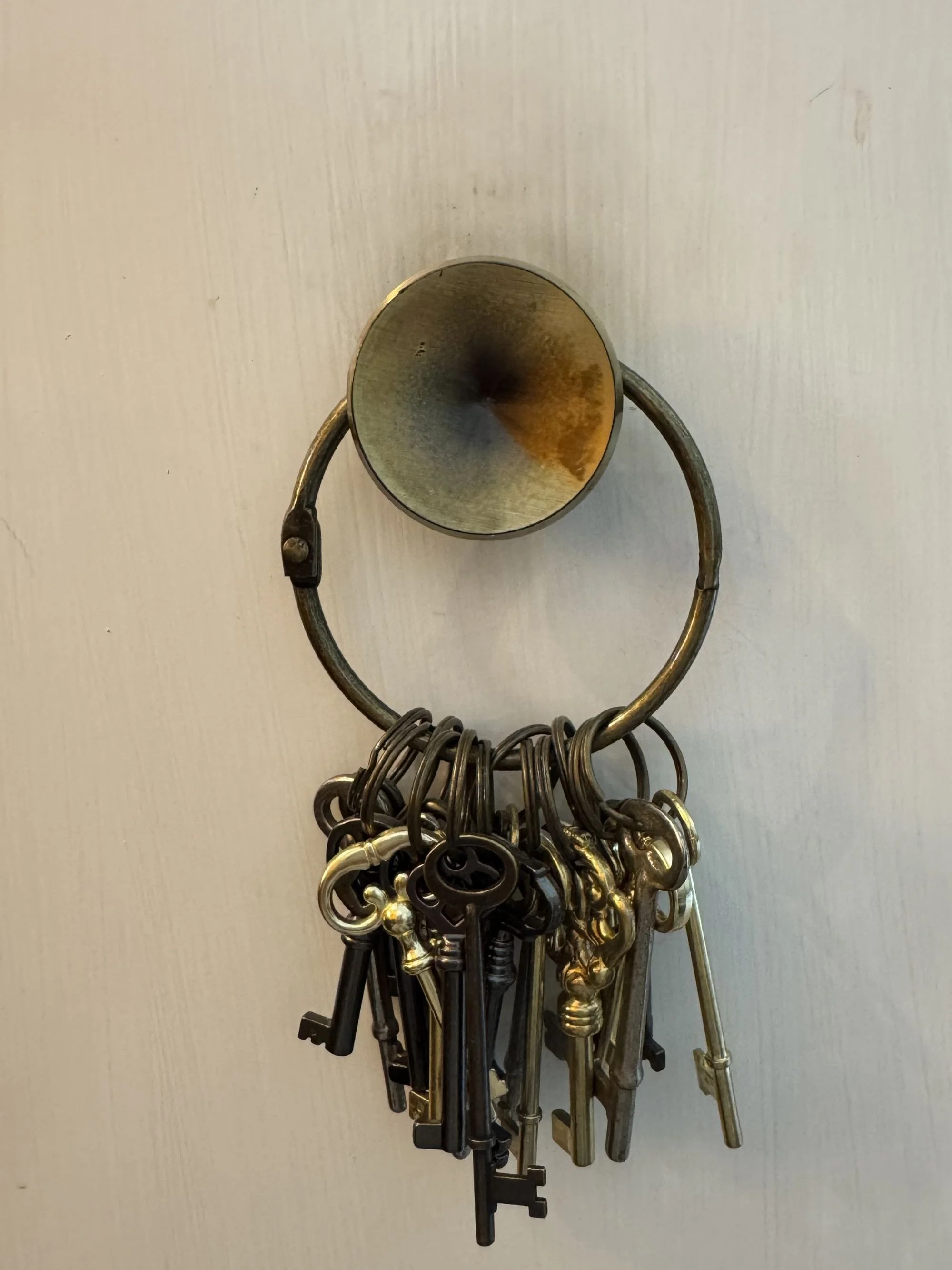
I actually love old skeleton keys. I think I got this from my mom. I don’t know. Or maybe there was an unwritten prequel to this story, because, when I cleaned out one of the drawers in the kitchen after both of my folks had passed away, I found an old Schwinn bag, and inside there were a dozen or so assorted skeleton keys. None of which, by the way, fit the desk lock. Had the desk locked itself once before and my dad bought a bunch of old skeleton keys to unlock it? I will never know. Anyway, I now have those skeleton keys, plus all the ones I bought, on a big, old keychain, hanging on a doorknob near (but not too close) to the old desk. That keychain also holds the one, the one and only, key that opens the desk.
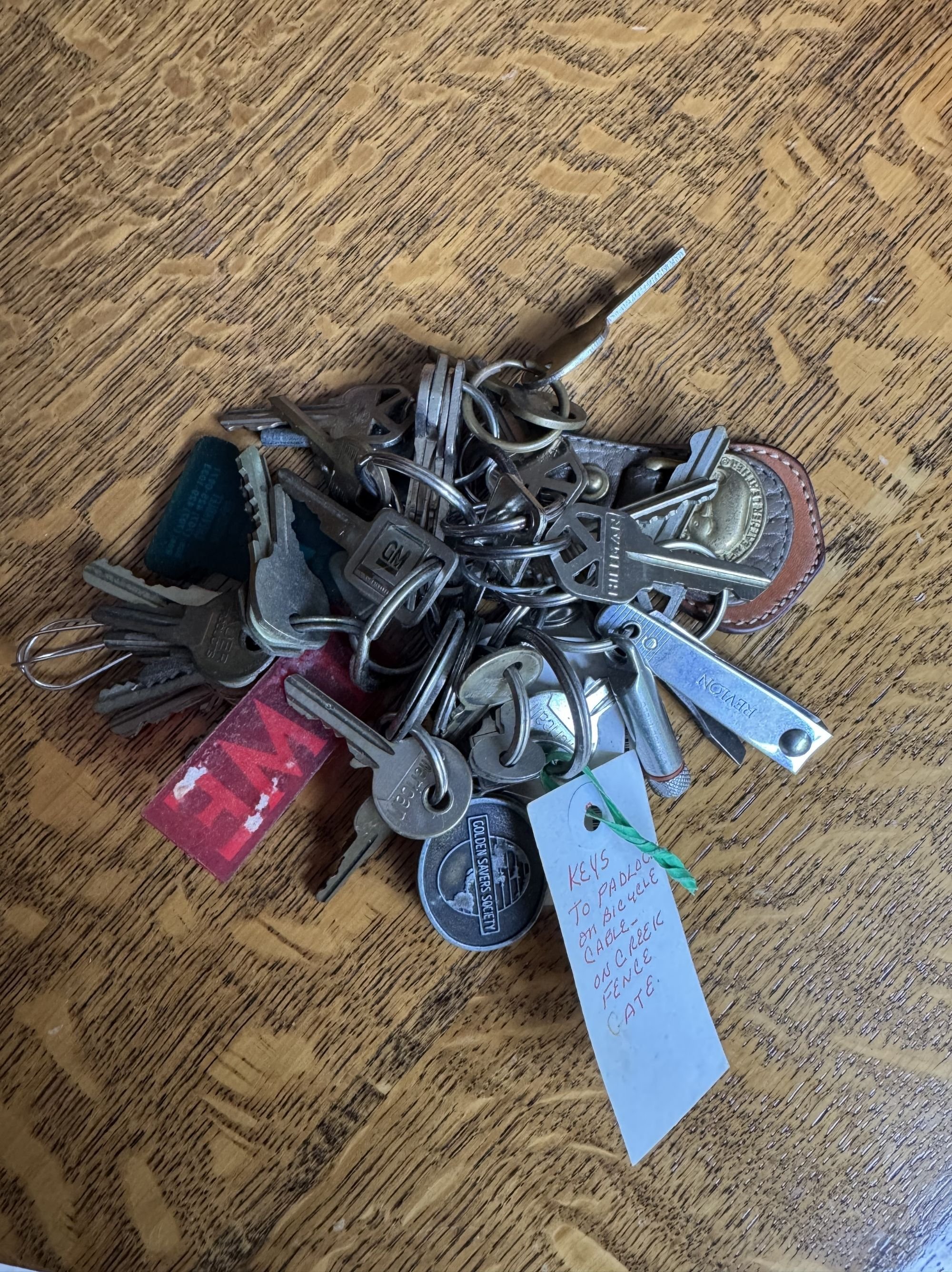
When I look at that collection of keys, it reminds me that we all have a collection of keys—possible solutions—each intended for a specific lock or purpose. And, as we go through life, we collect these keys, and try them. Sometimes they unlock one lock, but not another. But, they all unlock some lock, somewhere. We may just have to be patient and a little persistent, and keep the keys safe, and handy.
And this is why, in the Whole Woman Joy Circle, we don’t build pillars.
Pillars are fixed. Heavy. Immovable.
Keys, on the other hand, are meant to be carried.
Collected. Tried. Revisited.
They fit in your pocket. They travel with you. They meet you where you are.
And over time, you begin to recognize— which key opens which door.
And which ones are worth keeping close.
If this idea of “keys over pillars” speaks to you…
That’s exactly the kind of work we do inside the Whole Woman Joy Circle.
A place for midlife women to explore what actually fits—
and to build a life that feels like their own.